Already a member? The Mini Workbook Vault is waing in your Classroom. Log in →
New · 95% off for Daily Wellness readers
The Ultimate Mental Health Workbook Vault
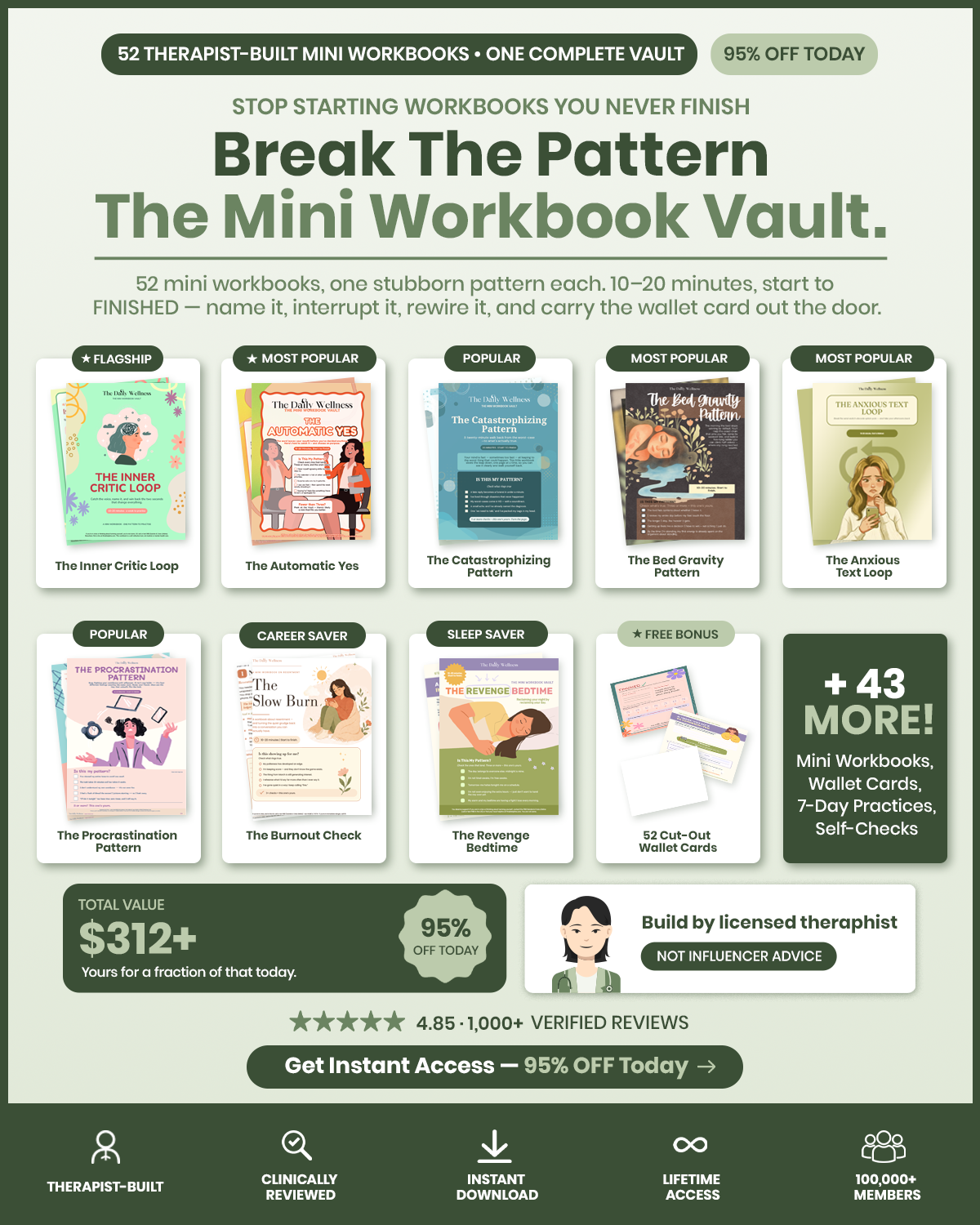
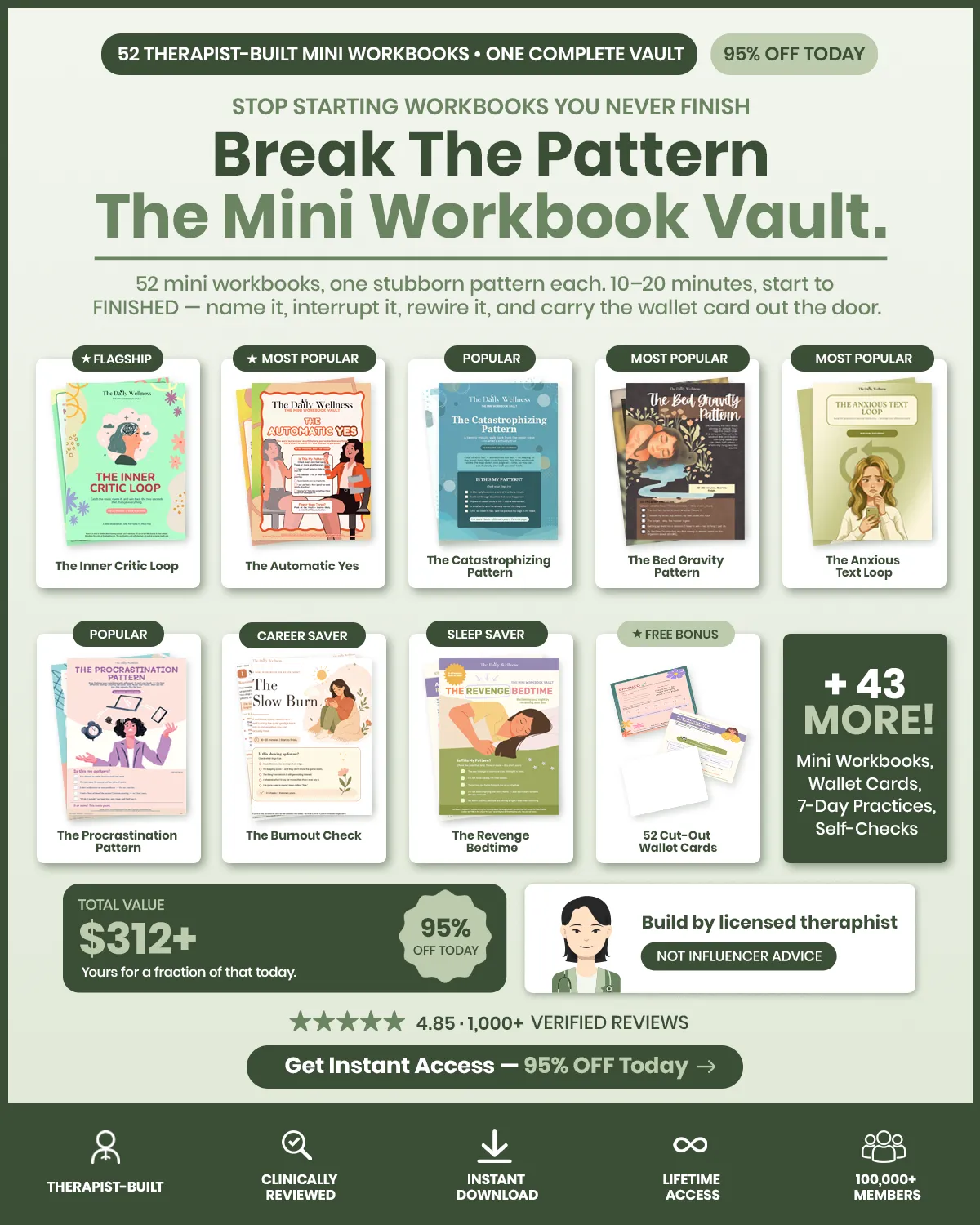
52 mini workbooks, each built around one paern and one sing of 10 to 20 minutes, so
you actually finish what you start.
Say No Without the Guilt. Quiet the Inner Critic. Finally Close the 2 A.M. Replay.

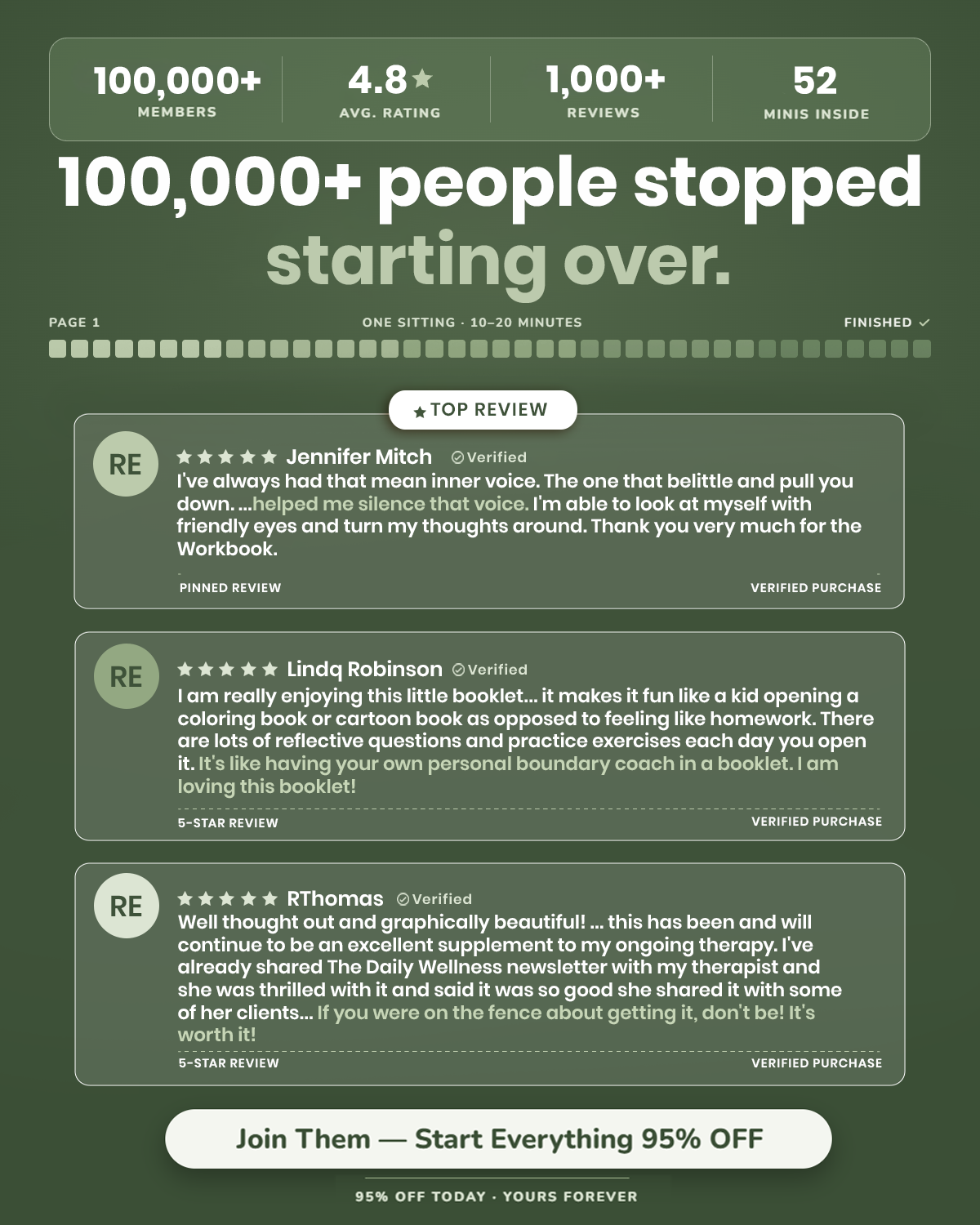
4.85 stars from 1,000+ Reviews | 100,000+ Members
You already know exactly what you do. What you’ve never had is a way to work on one paern without signing up for a 200-page project. Each mini takes a single paern from “that’s me” to a plan in your wallet, in one sing.
Finish what you start — every mini is built for one sitting and ends on a page that says FINISHED.
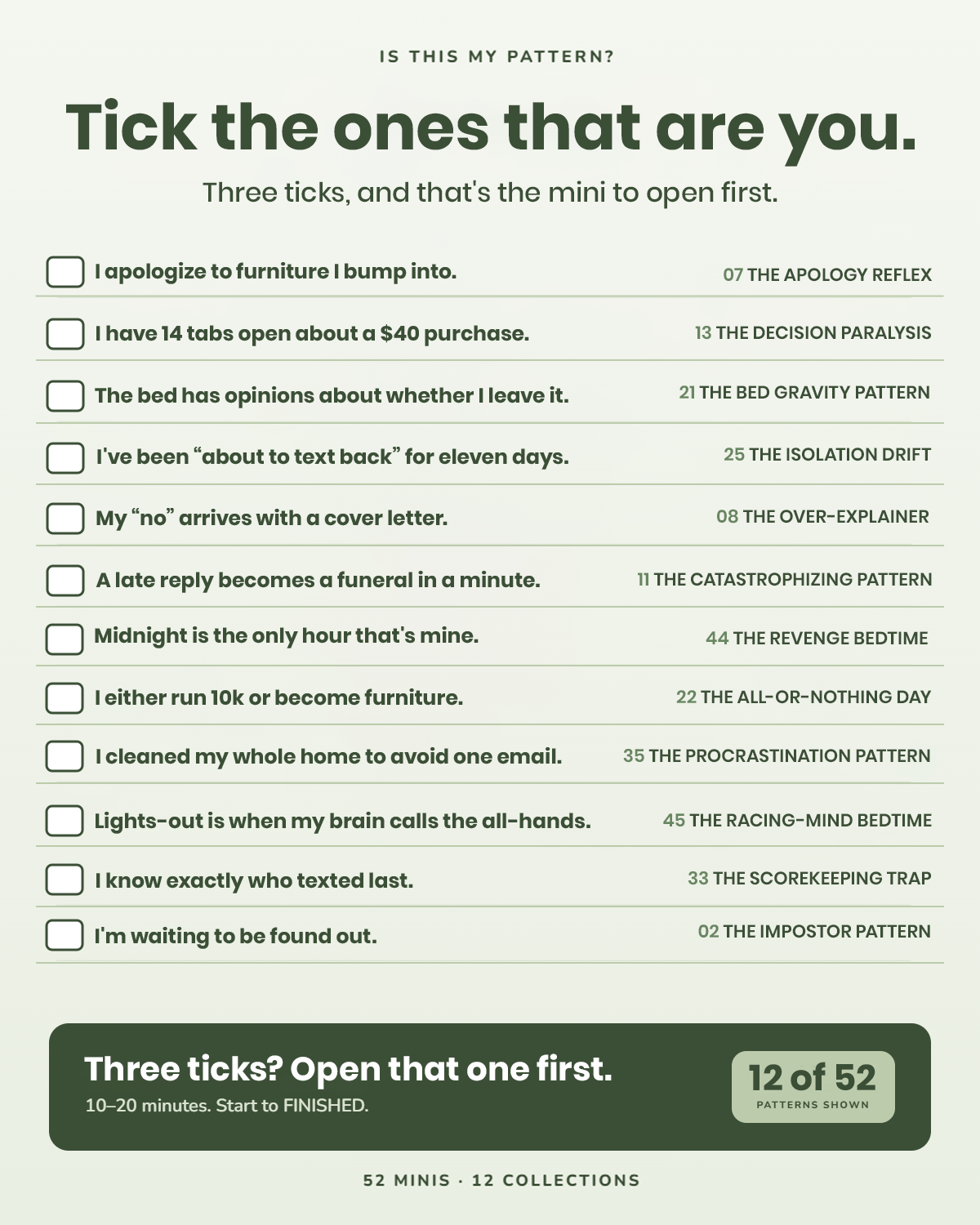
Know in 60 seconds if it’s yours — a five-line self-check opens every workbook. Three ticks and you’re in the right one
Catch the pattern in the act — each mini hands you one interrupt line, the exact words for the moment it fires
Leave with something in your pocket — a cut-out wallet card and a 7-day micro-practice, so the insight survives Monday
Start wherever it hurts — 52 patterns across 12 collections, from the inner critic and people-pleasing to burnout and sleep
One payment or join. Instant access.
Supportive self-help tools, not therapy or emergency care.
Your 95% Discount Ends In
The Mini Workbook Vault is open only to The Daily Wellness community, by email invitation. Right now, all 52 workbooks are yours for one payment (95% off), with no subscription. When the countdown ends, so does the discount.
1,000+
verified ratings
100,000+
Members
100,000+
Members
Therapist
Created and reviewed
Instant
Access
52
mini workbooks
Therapist
Reviewed
Instant
Access
52
Mini workbooks
AS SEEN IN





Endorsed by Licensed Therapists
& Mental Health Professionals
Every professional below has independently reviewed The Daily Wellness and endorses our content and products — spanning anxiety, depression, trauma, burnout, and more.
Real experts. Real endorsements. No exceptions.
APA Verified Members
HIPAA Compliant
License Board Verified
Conflict of Interest Disclosed
WHAT REPEATING A PATTERN ACTUALLY LOOKS LIKE
You Said Yes Again. You Replayed It Again. You
Promised Yourself “Never Again.” Again.
You might know one of these by heart:
The automatic yes
You hear yourself agreeing while your chest says no.
The replay loop
One conversaon, re-run like it’s under appeal.
The inner critic
Words you’d never use on a friend, on a loop, in your own voice
The all-or-nothing day
You either run 10k or become furniture
The revenge bedtime
The day belonged to everyone else, so midnight is yours.
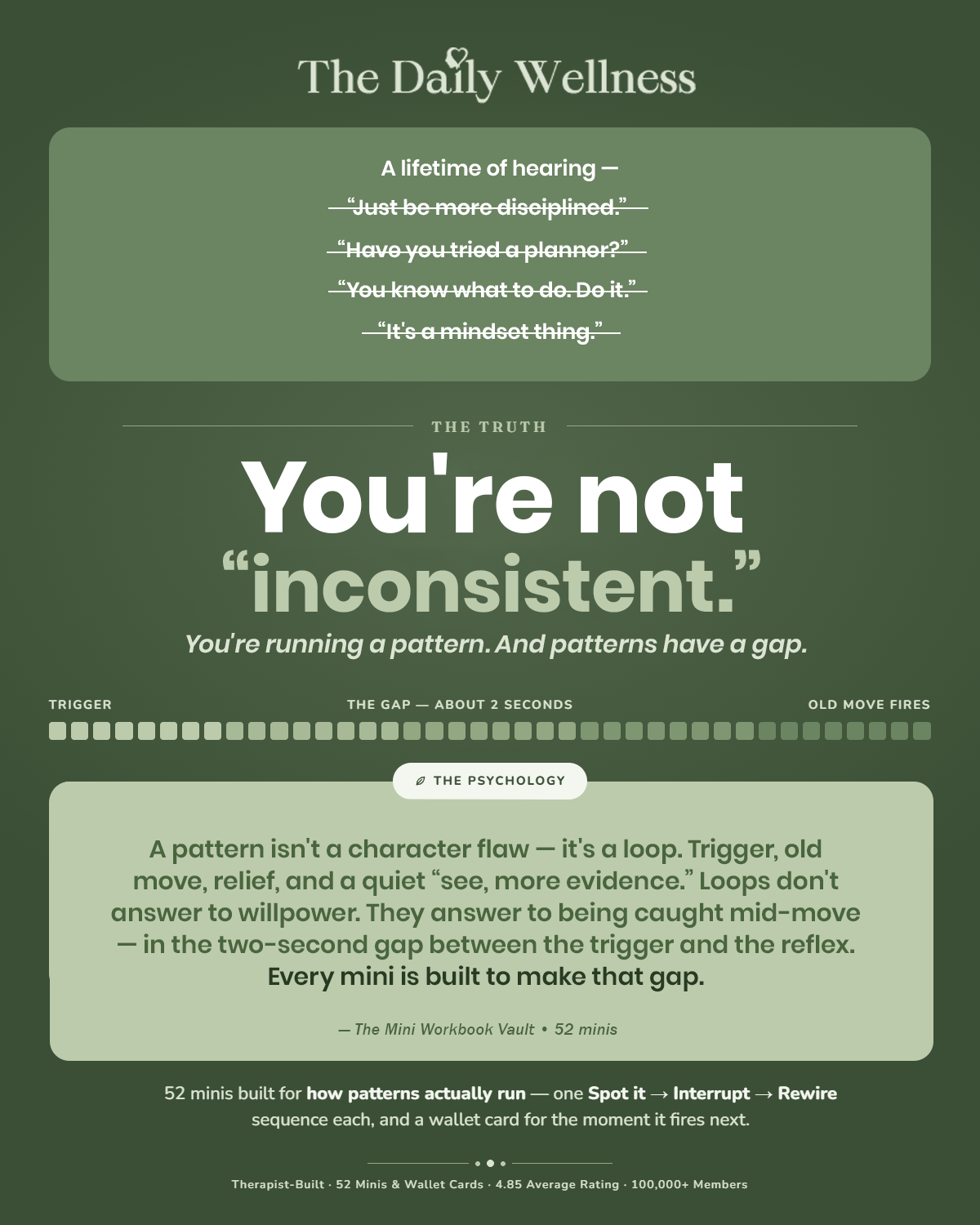
“Why do I keep doing this?”
There’s an honest answer to that. And it isn’t about willpower
WHY INSIGHT HASN'T CHANGED IT
It’s Not You. It’s the 200-Page Workbook.
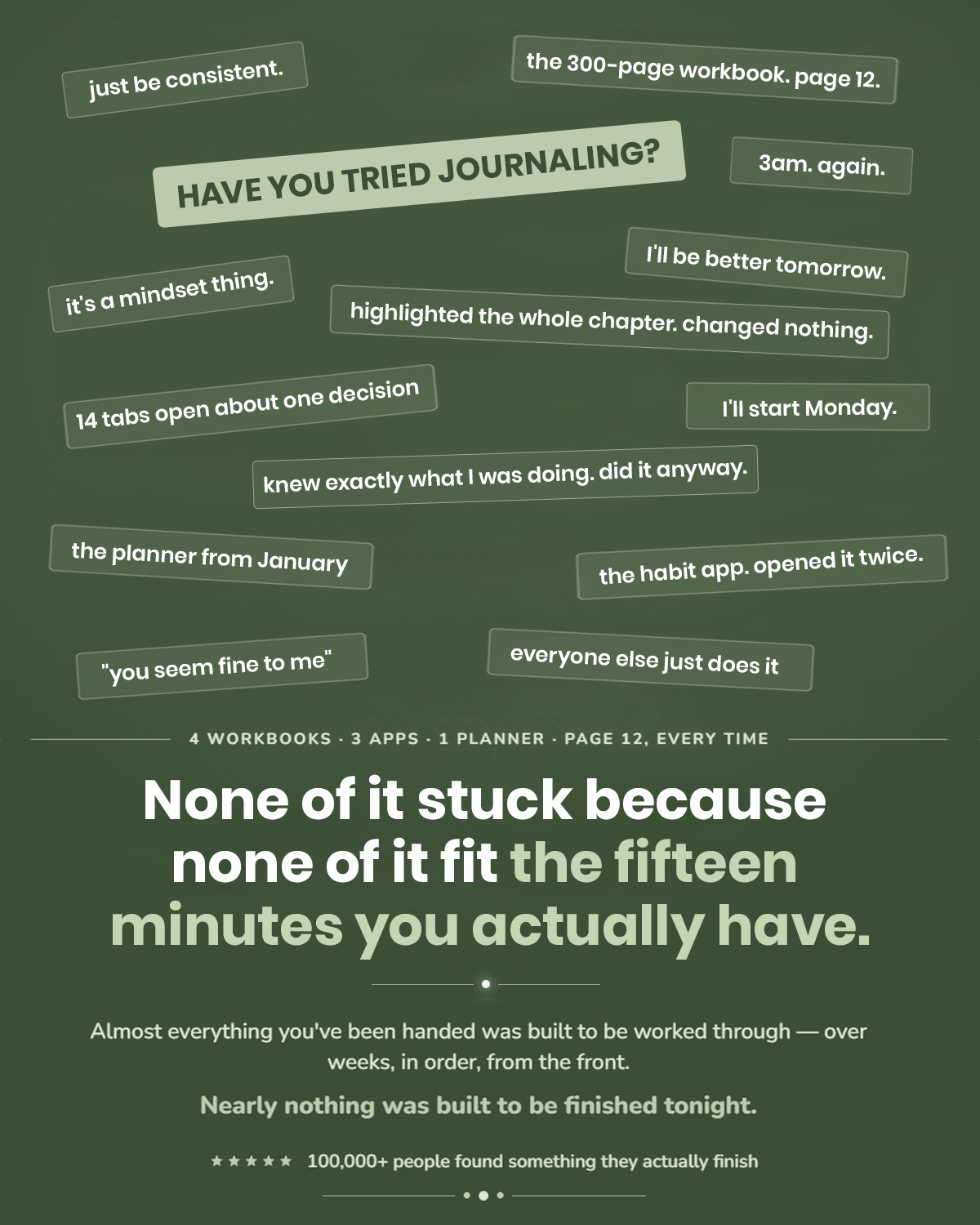
You’ve had the insight. You can explain your paerns beer than most self-help books. But insight without a finish line changes nothing, and most workbooks are built like textbooks: huge, open-ended and abandoned by chapter two. The paern carries on. The workbook gathers dust.
It feels like you failed.
You didn’t. The format did.
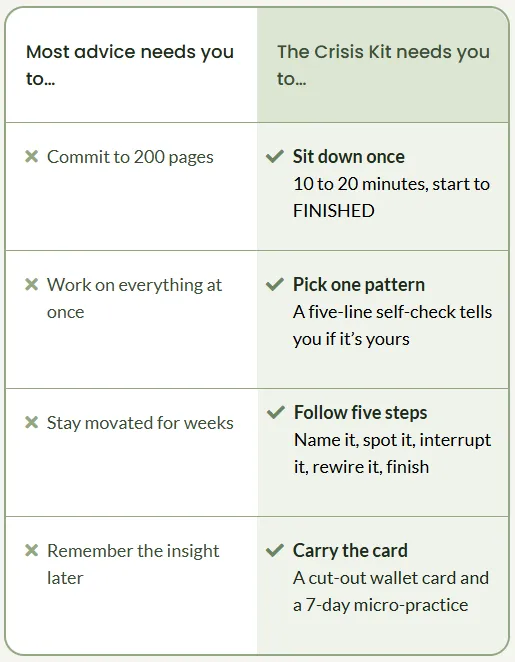
Most advice needs you to…
The Crisis Kit needs you to…
Commit to 200 pages
Sit down once
10 to 20 minutes, start to FINISHED
Work on everything at once
Pick one pattern
A five-line self-check tells you if it’s yours
Stay movated for weeks
Follow five steps
Name it, spot it, interrupt it, rewire it, finish
Remember the insight later
Carry the card
A cut-out wallet card and a 7-day micro-practice
What If the Next Hard Moment Looked Like This?
About to say yes? You hear yourself say, "Let me check and get back to you."
Critic starting up? You say four words, "The critic is talking," and there's a gap.
Replay starting? "This case has been heard." And you put it down.
Dreading the week? You remember your forecasts run too dark, by a number you worked out yourself.
11:40 p.m. and still scrolling? One question on a card: "Who pays for this hour?"
This won’t make you a different
person by Friday.
It gives you the next move, at the moment the old one fires.
Exclusive to The Daily Wellness community.
Built to Be Trusted. And Actually Finished.

Created and reviewed
by licensed therapists
Every workbook is written and checked by licensed mental health professionals before release.

Built on skills therapists teach
Thought records, behavioral
experiments, exposure ladders, boundary scripts, self-compassion. In plain words, jargon removed.

Finished in one sitting
No blank pages. Every exercise has small fields and a filled-in example, so you never face an empty format cold.

Honest about its limits
Where a pattern needs more than a worksheet, the workbook says so plainly and points you to professional
support.
"This is the fourth workbook I have bought… I can say the items they offer to purchase are not fluff… They put their sweat and tears into these. They actually care about the people who read their emails and purchase their products."
Lori · Verified review of The Daily Wellness tools
Over 100,000 people already trust The Daily Wellness with their hard stuff.
There’s a workbook built for exactly your pattern. It’s just never been this short.
introducing
The Mini Workbook Vault
52 Mini Workbooks. 12 Collections. One Pattern at a Time.
52
MINI WORKBOOKS
12
COLLECTIONS
10-20
MINUTES, START TO FINISHED
5
STEPS IN EVERY WORKBOOK
52
CUT-OUT WALLET CARDS
52
MINI WORKBOOKS
100,000+
Members
12
COLLECTIONS
Clinically
Reviewed
Instant
Access
Keep Your
Downloads
10-12
MINUTES, START
TO FINISHED
5
STEPS IN EVERY WORKBOOK
52
CUT-OUT WALLET CARDS
Every mini follows the same five steps: check it’s your pattern, name it, spot it in your own week, learn the one line that interrupts it, and rewire it on paper. You finish with a wallet card and a 7-day micro-practice. No 200-page commitment. Pick the pattern that’s loudest this week and start there.
4.85 from 1,000+ verified ratings | 100,000+ Customers
Here’s Exactly What’s Inside
All 52 workbooks, grouped by the pattern they work on.
Collection 1
The Inner Critic & Self-Worth
For the voice that's harder on you than anyone else is.
5 workbooks
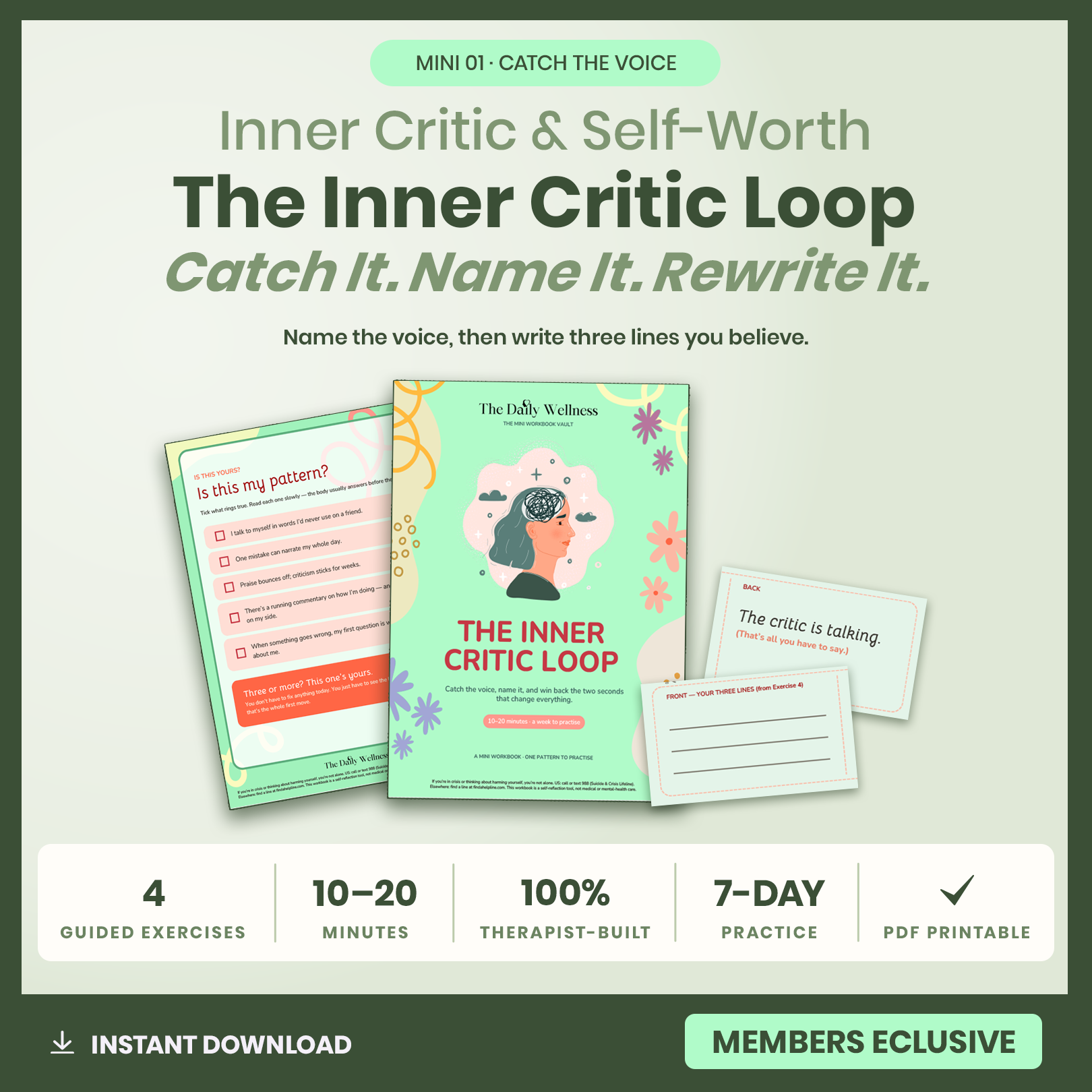
WORKBOOK 01
The Inner Critic Loop
Use this when: you talk to yourself in words you’d never use on a friend.
Your critic is a smoke alarm wired too sensitive: loud, sincere, and wrong about the fire. You log its exact lines, learn the four words that open a gap (“The critic is talking”), and build three replies your brain accepts without eye-rolling.

WORKBOOK 02
The Impostor Pattern
Use this when: you’re waiting to be found out.
You’ve been converting every win into someone else’s currency: luck, timing, a nice boss. The Discount Audit shows you the exchange rate. You leave with a Hired-for-Reasons page and one line for the next spike: frauds don’t lie awake worrying about being frauds.
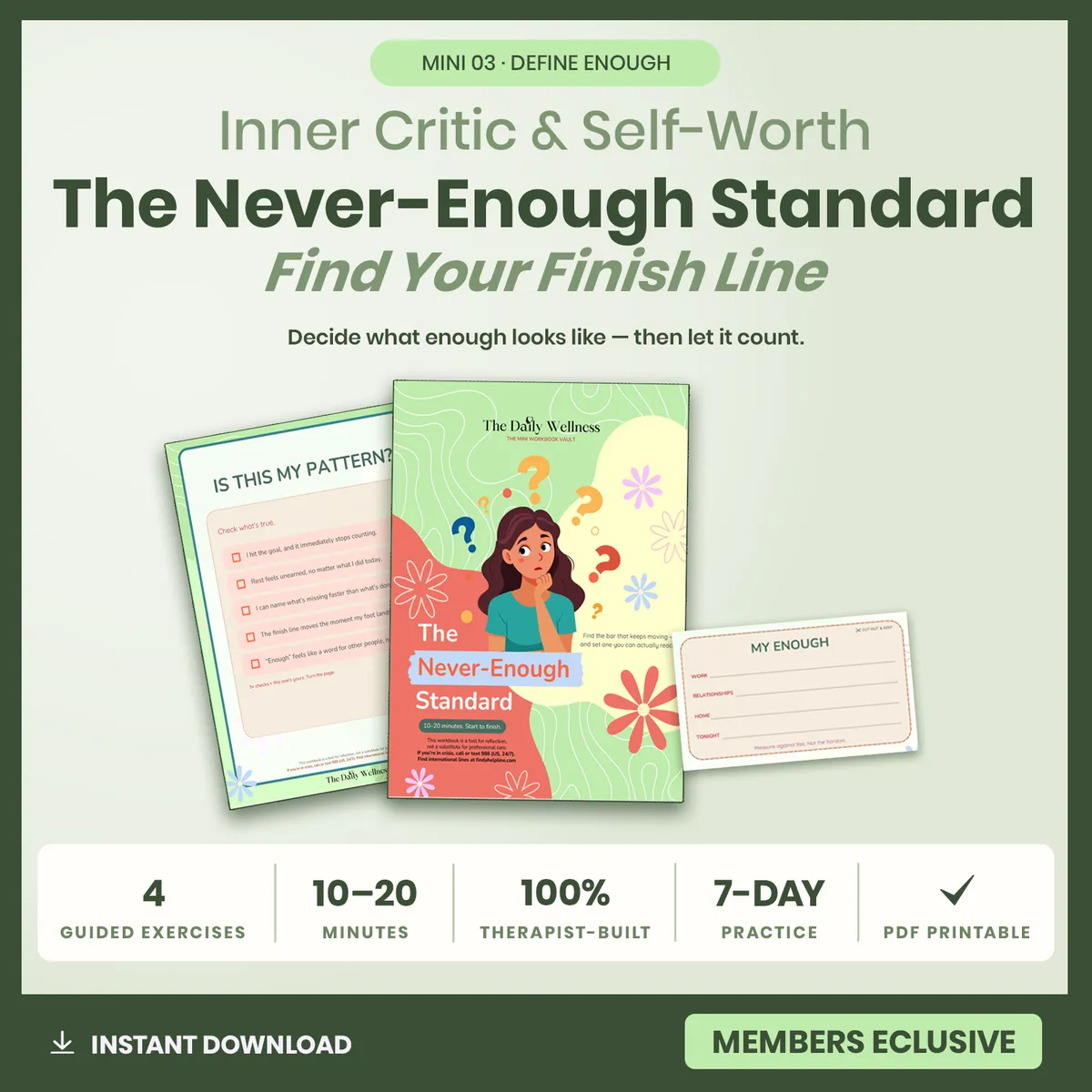
WORKBOOK 03
The Never-Enough Standard
Use this when: you hit the goal and it immediately stops counting.
That isn’t a standard, it’s a treadmill: a bar that moves as you approach it. You write down the rules you actually live by, ask who installed them, and define “enough” in your own words, concrete and reachable.
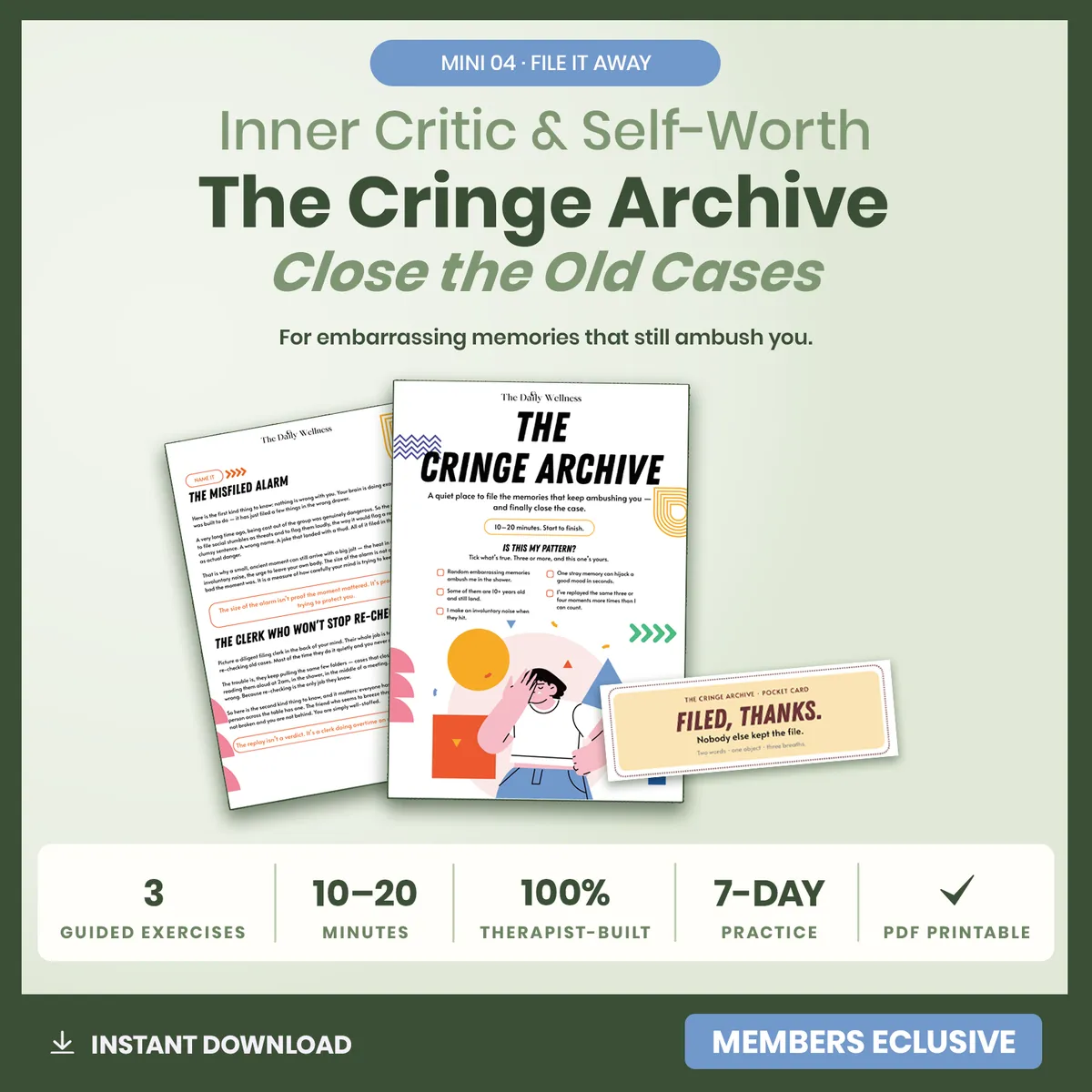
WORKBOOK 04
The Cringe Archive
Use this when: a ten-year-old embarrassing memory ambushes you in the shower.
Your brain’s filing clerk keeps re-checking a case that closed years ago. You run an audience audit on your repeat offenders (who was there, and when did they last think of it?), learn the filing move, and stamp each one case closed.
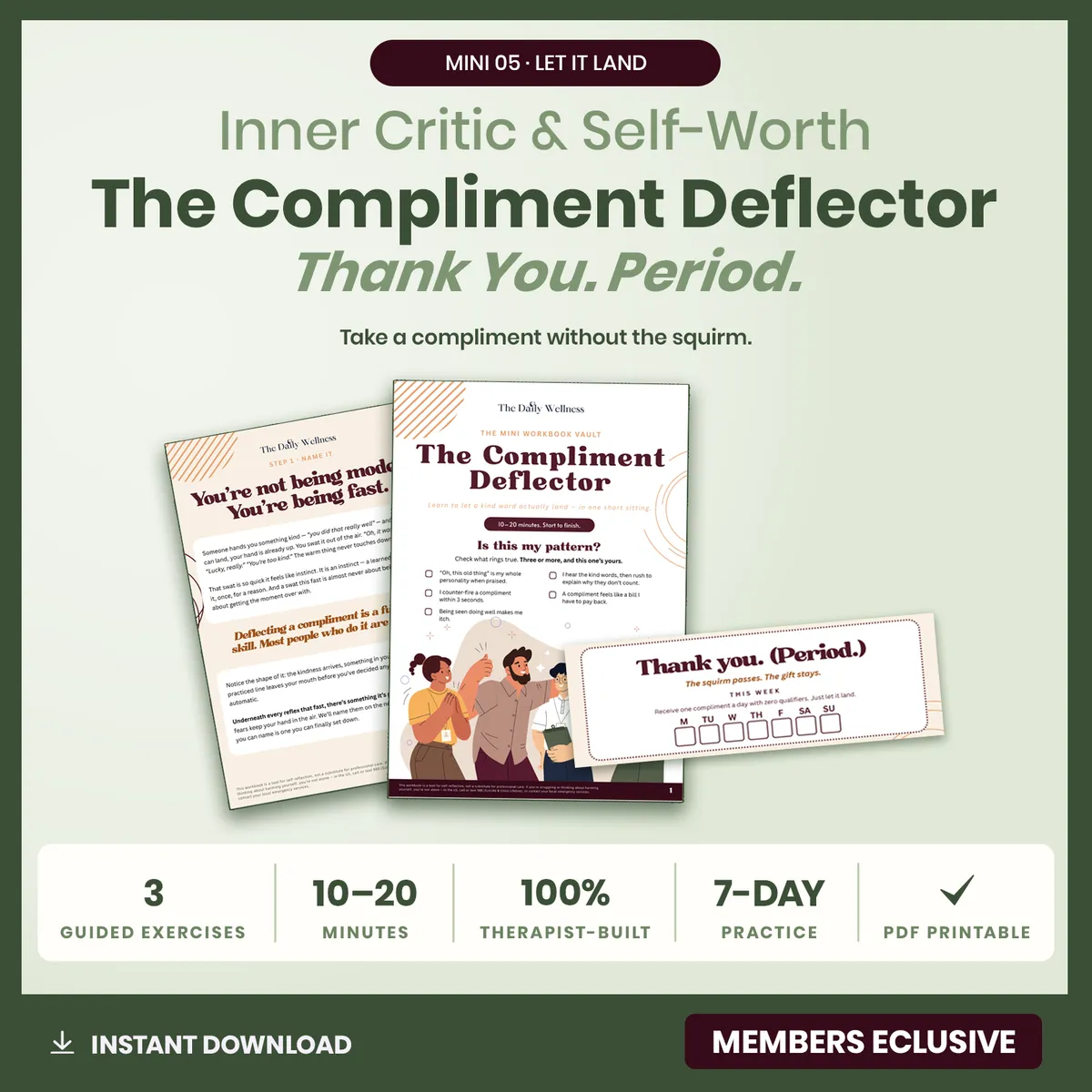
WORKBOOK 05
The Compliment Deflector
Use this when: “oh, this old thing” is your whole personality when praised.
Deflecting doesn’t read as humble. It swats a gift out of the air. You spot your signature move, learn the three-second receive (eye contact, “thank you,” full stop), and practice it on paper until the squirm gets smaller.
COLLECTION 2
People-Pleasing & Boundaries
For the yes that leaves before you’ve decided.
5 workbooks
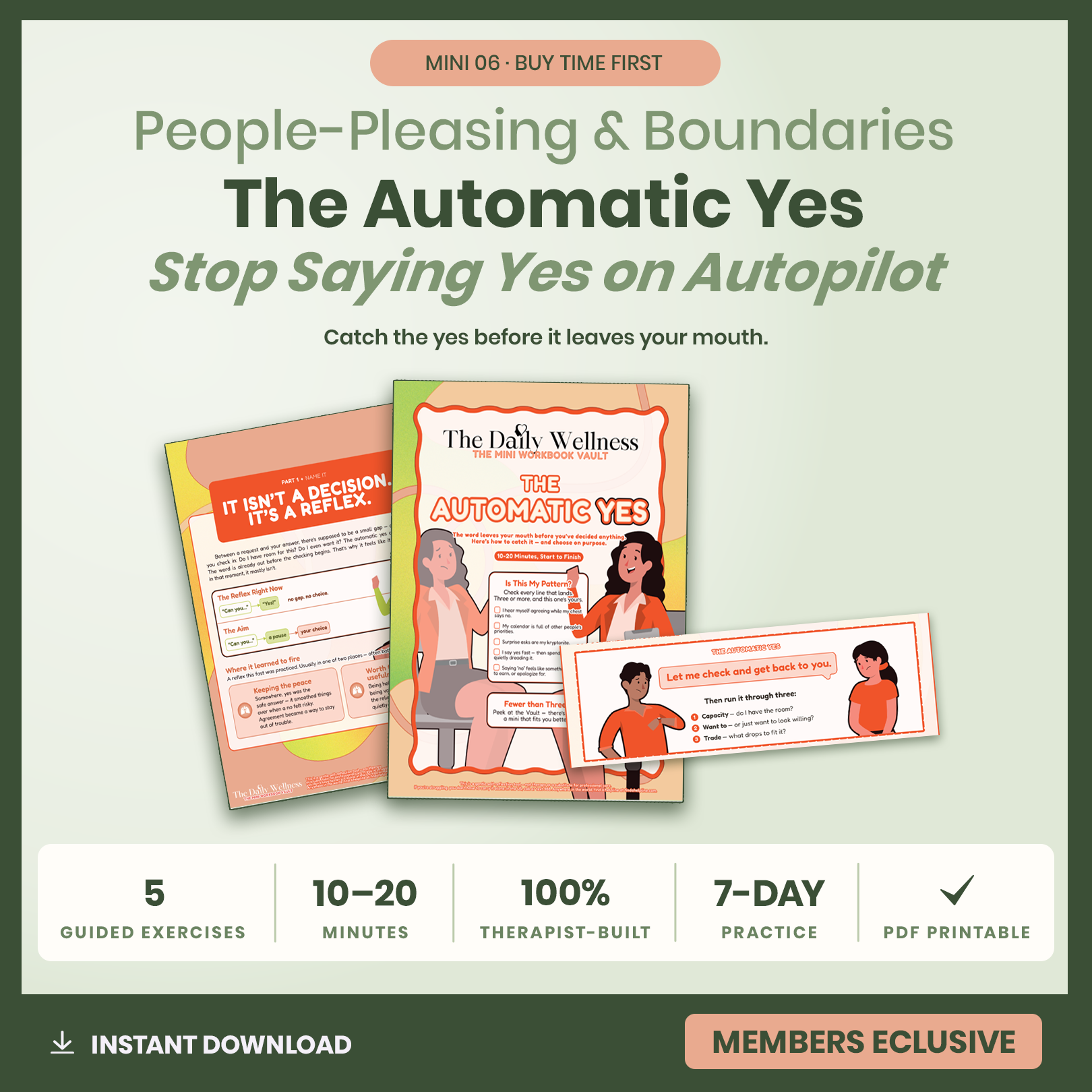
WORKBOOK 06
The Automatic Yes
Use this when: you hear yourself agreeing
while your chest says no.
The yes fires before the decision starts. You
audit this week’s yeses, install one buy-time line (“Let me check and get back to you”), and run two pending asks through a three-question filter. There’s even a draft for the yes you need to take back.
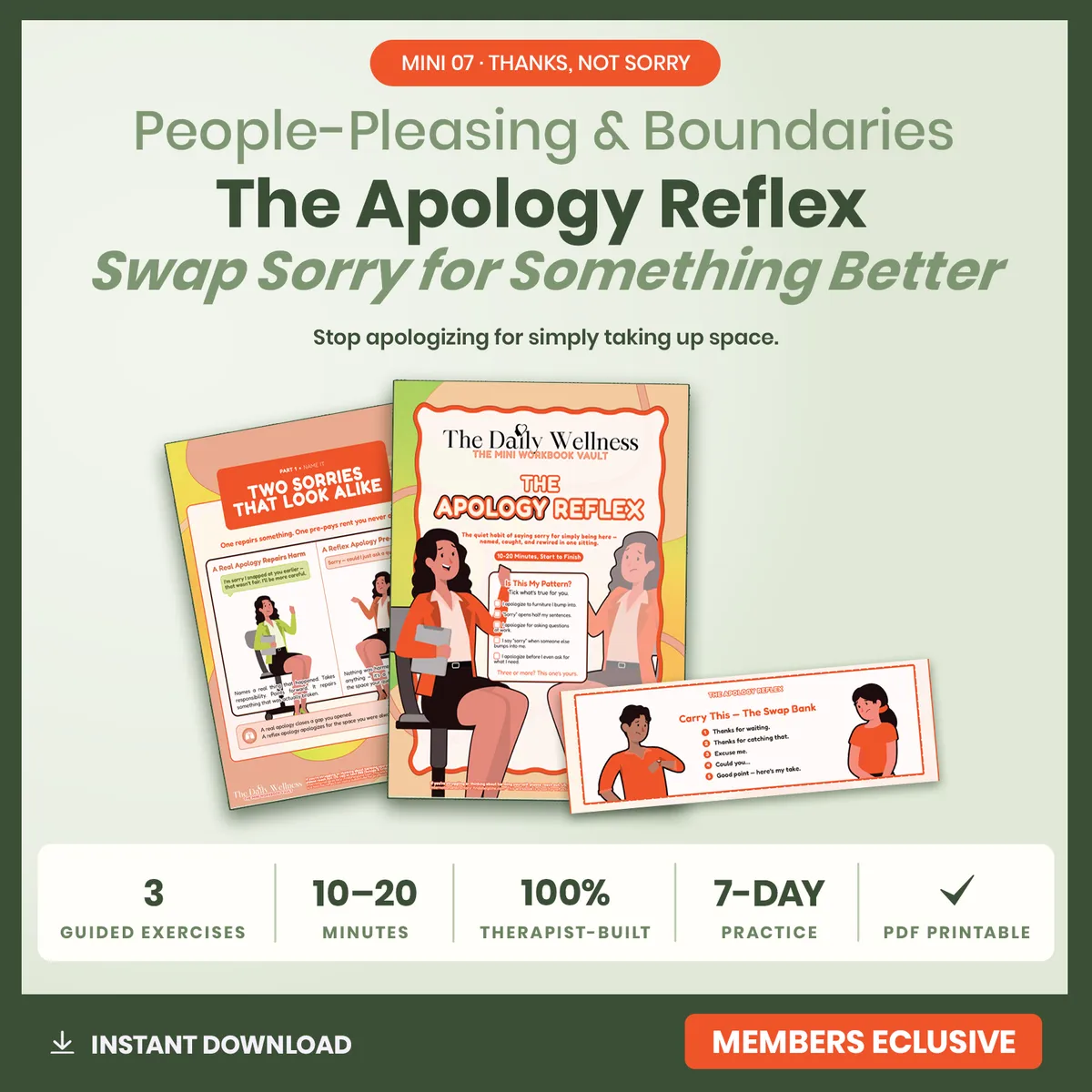
WORKBOOK 07
The Apology Reflex
Use this when: you’ve apologized to
furniture.
A real apology repairs harm. A reflex apology pre-pays rent for taking up space. You log 48 hours of sorries, sort the real from the reflex, and rehearse five swaps, starting with “thanks for waiting.”
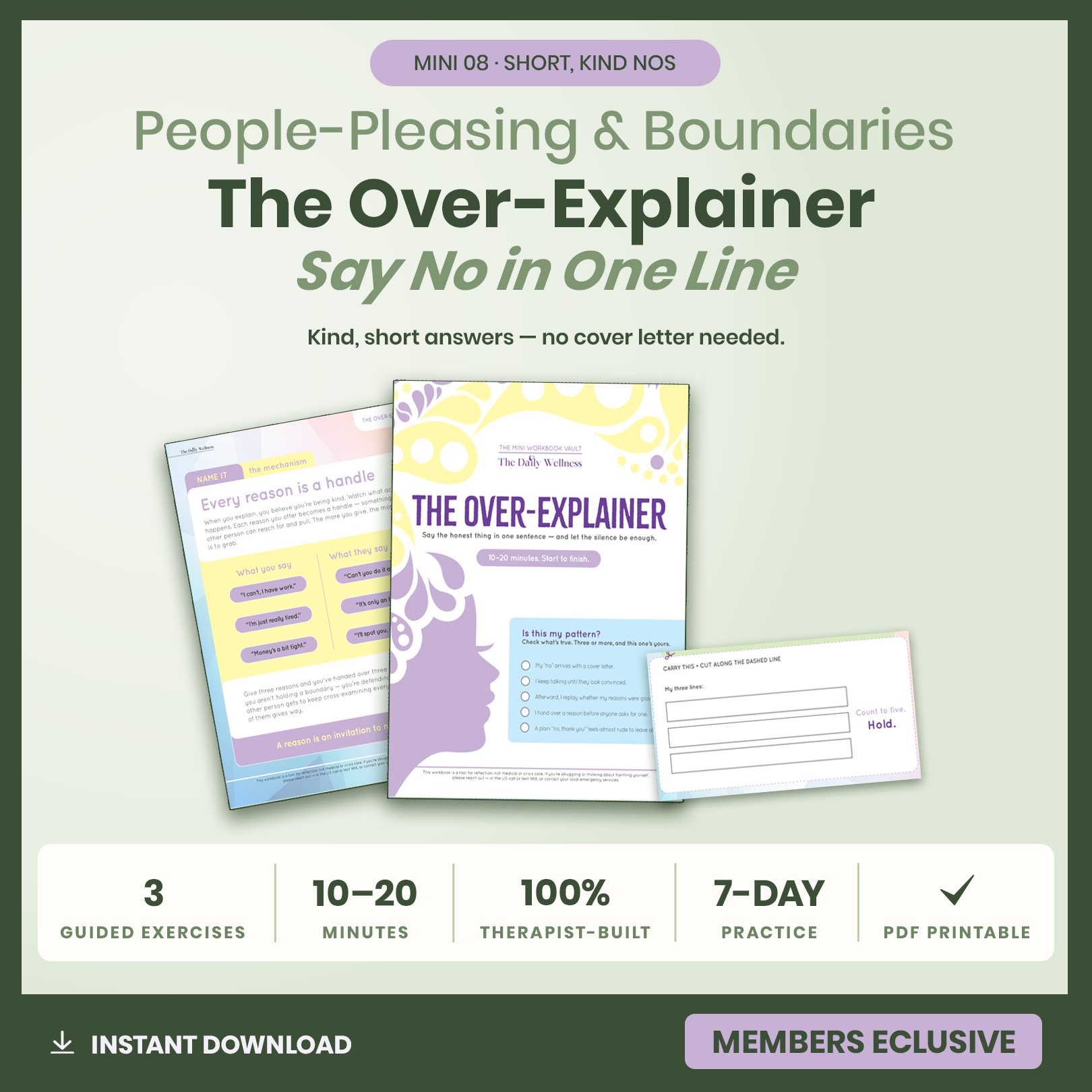
WORKBOOK 08
The Over-Explainer
Use this when: your “no” arrives with a cover letter.
Every reason you give is a handle someone can argue with. You take three recent essays apart, find the two-word answer buried inside, and rewrite each as warmth plus answer. Then you practice the hardest part: counting to five in the silence.
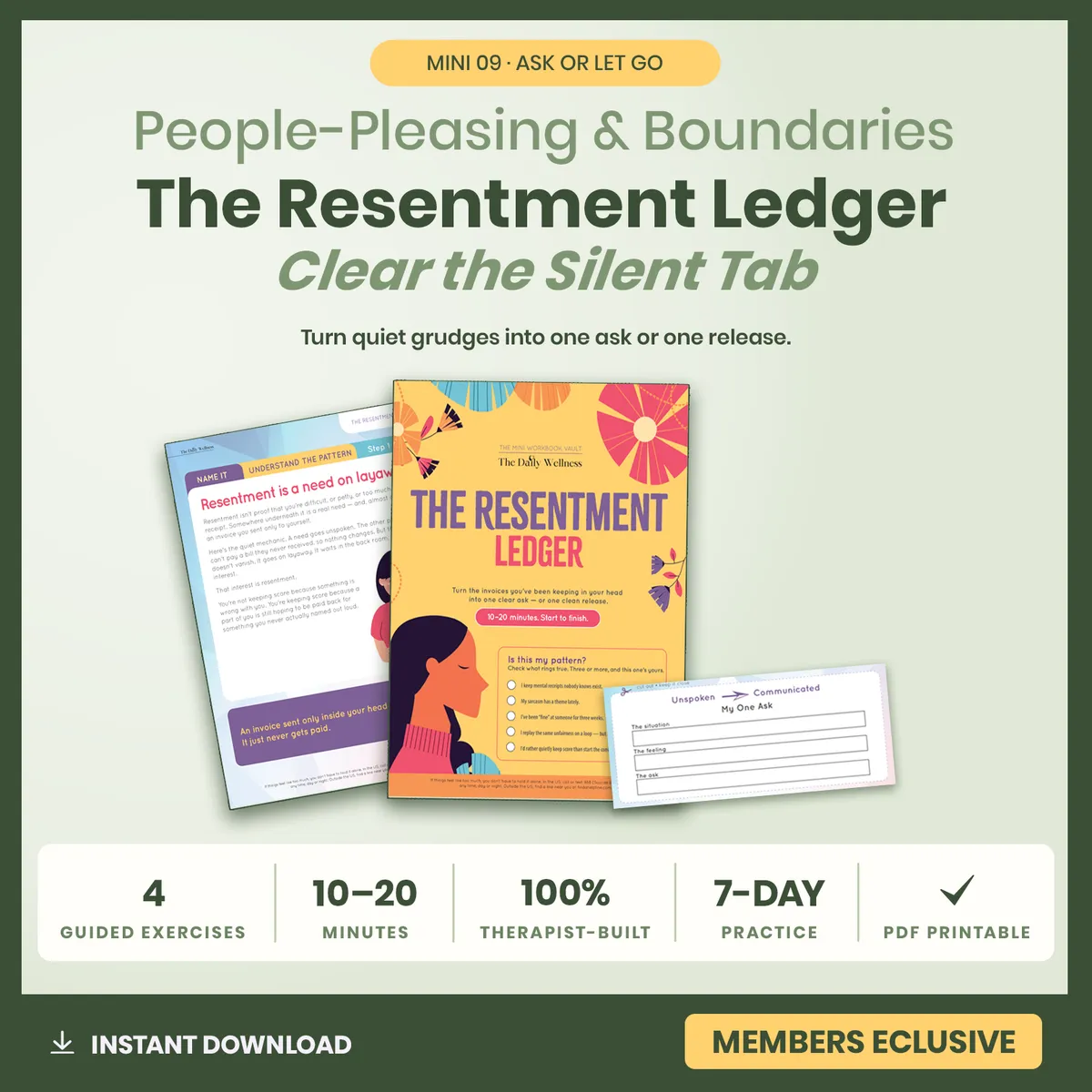
WORKBOOK 09
The Resentment Ledger
Use this when: you’ve been “fine” at
someone for three weeks.
Resentment is a need on layaway: invoices sent only inside your head. You write out the full ledger, petty items included, and find the unvoiced need under each. You finish with one ask drafted and dated, and one item formally taken off the books.
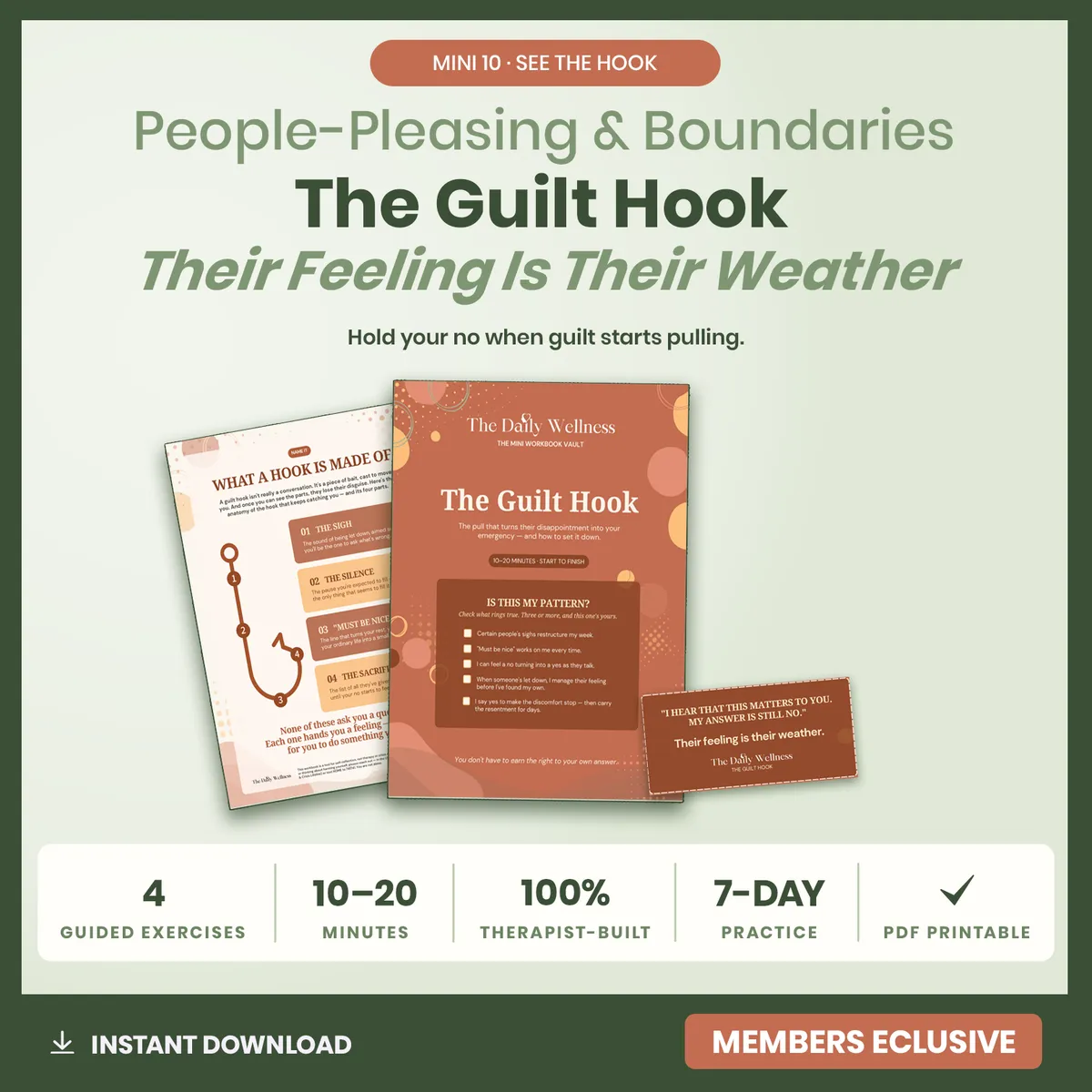
WORKBOOK 10
The Guilt Hook
Use this when: one person’s sigh can restructure your whole week.
A hook turns their disappointment into your emergency, and it only works if you pick it up. You map who hooks you and how,
separate their feeling from your responsibility, and draft the line that holds: “I hear that this matters to you. My answer is still no.”
COLLECTION 3
Overthinking & Worry
For the mind that won’t close the tab.
5 workbooks
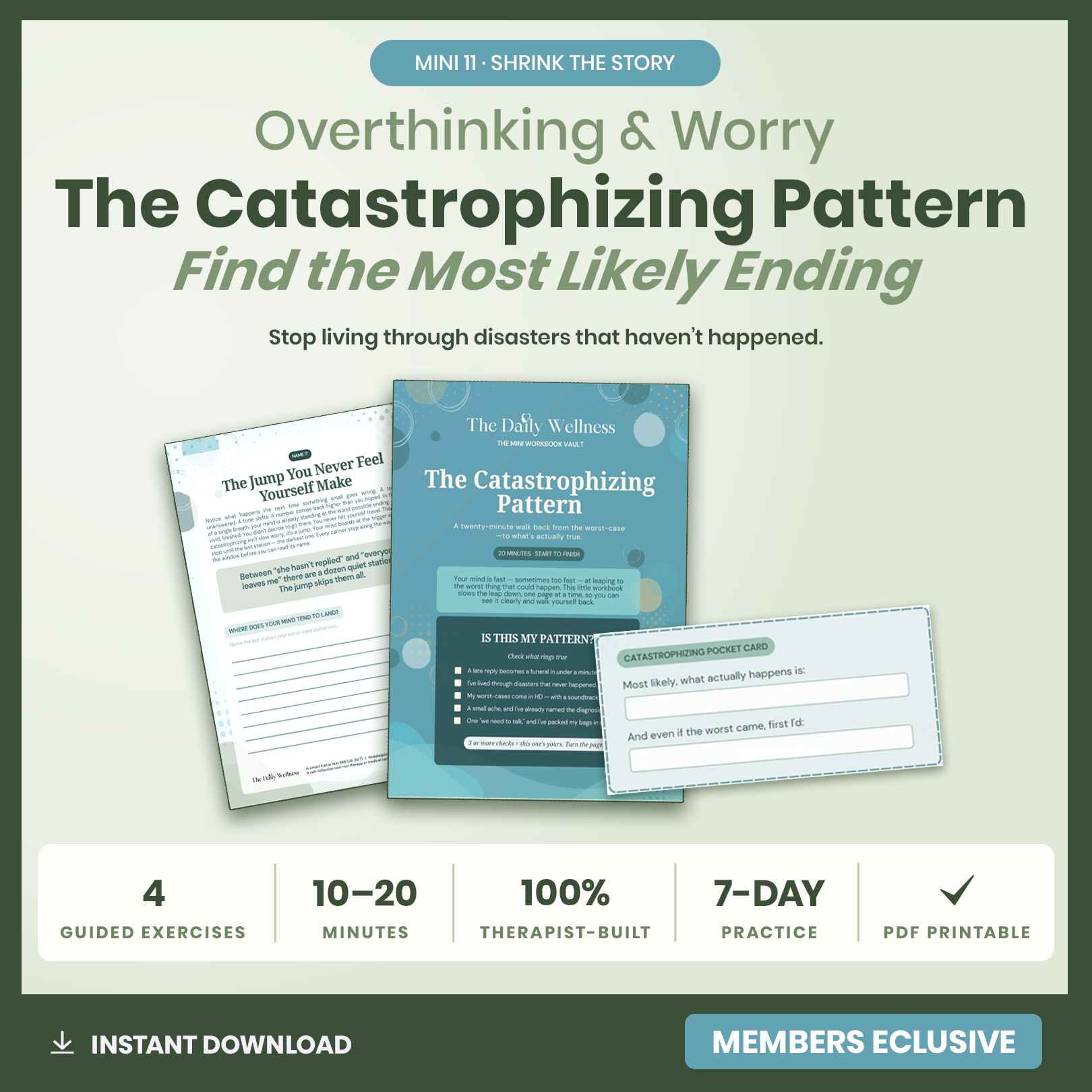
WORKBOOK 11
The Catastrophizing Pattern
Use this when: a late reply becomes a funeral in under a minute.
Your mind sprints from trigger to worst ending and skips every station between. You write the disaster out once, mark where fact ends and fiction begins, and walk the odds: best case, worst case, most likely. Then you plan for the sliver anyway.
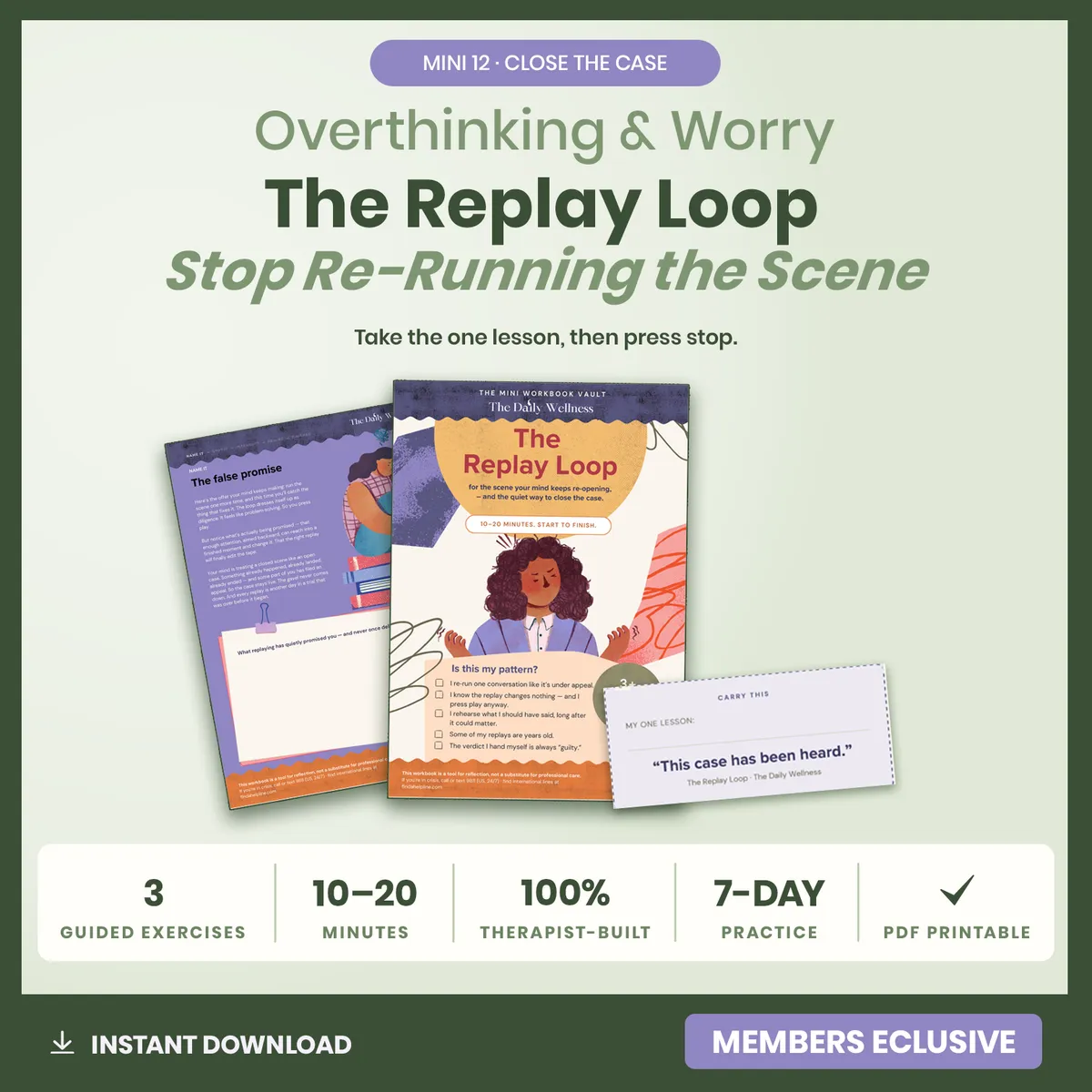
WORKBOOK 12
The Replay Loop
Use this when: you re-run one conversation
like it’s under appeal.
The loop promises that enough replays will fix the scene. Replaying is not repairing. You open the case file, count the replays and what they changed (zero), extract the one lesson in a single sentence, and sign the certificate that closes the case.
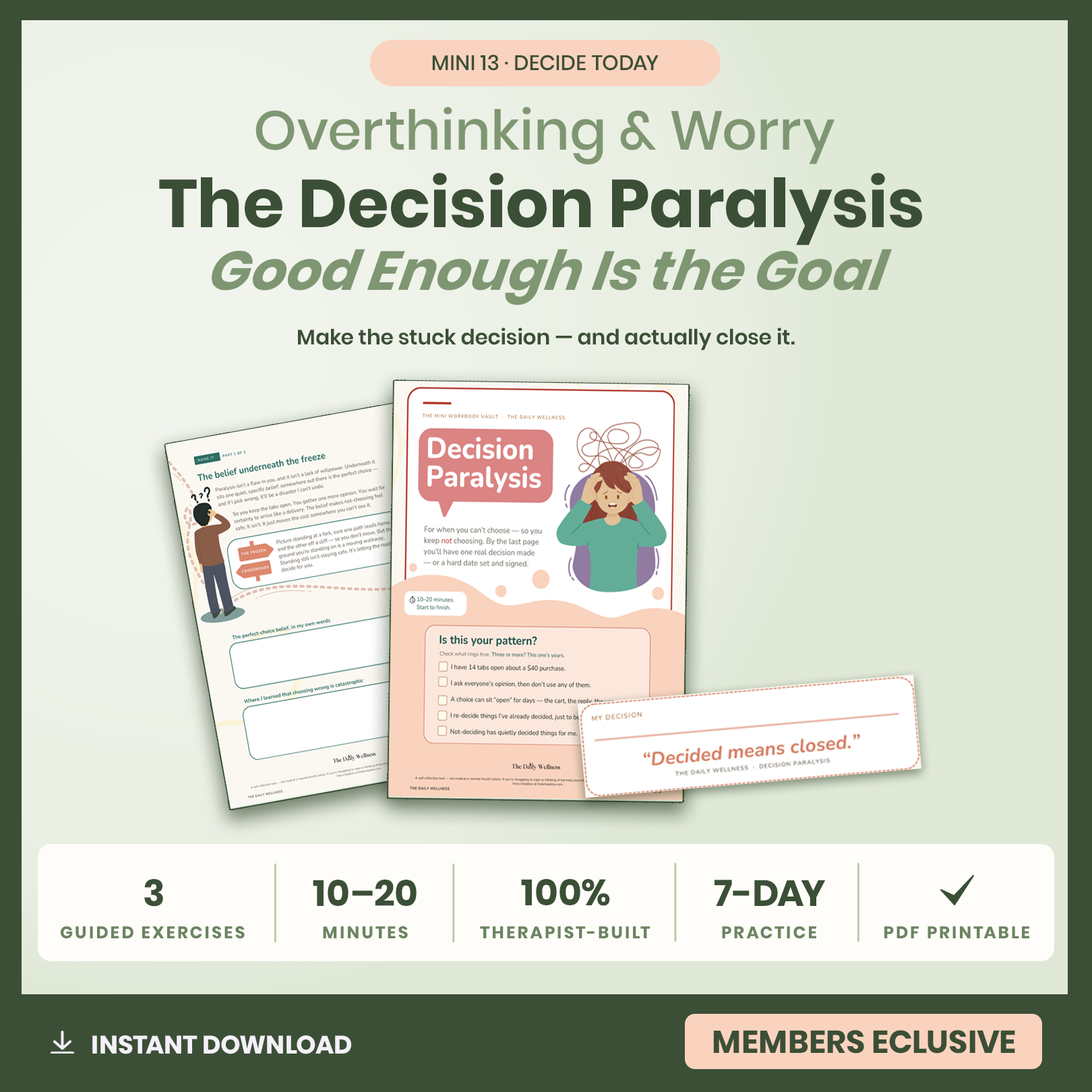
WORKBOOK 13
The Decision Paralysis
Use this when: you have fourteen tabs open
about a $40 purchase.
Not choosing is a choice, and usually the worst one on the menu. You take one stuck decision through 10/10/10, learn the good-enough rule (reversible and 80 percent sure means go), and write the decision in a box, with a date.
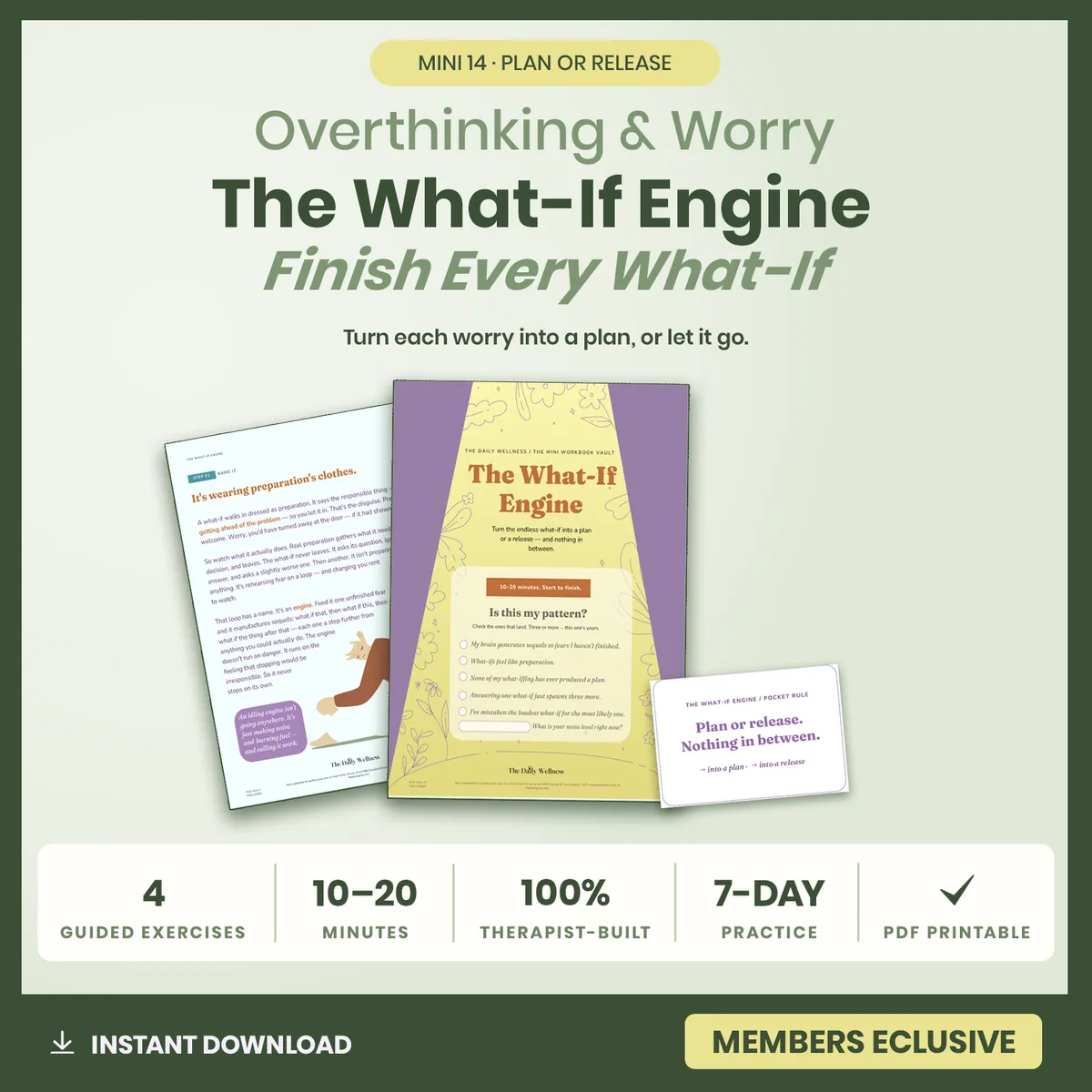
WORKBOOK 14
The What-If Engine
Use this when: your brain writes sequels to
fears you haven’t finished.
What-ifs dress up as preparation, but
preparation ends in a plan and worry ends in
another what-if. You dump your ten loudest,
sort them into actionable or not, give two a
next step, and release the other eight, initialed.
WORKBOOK 15
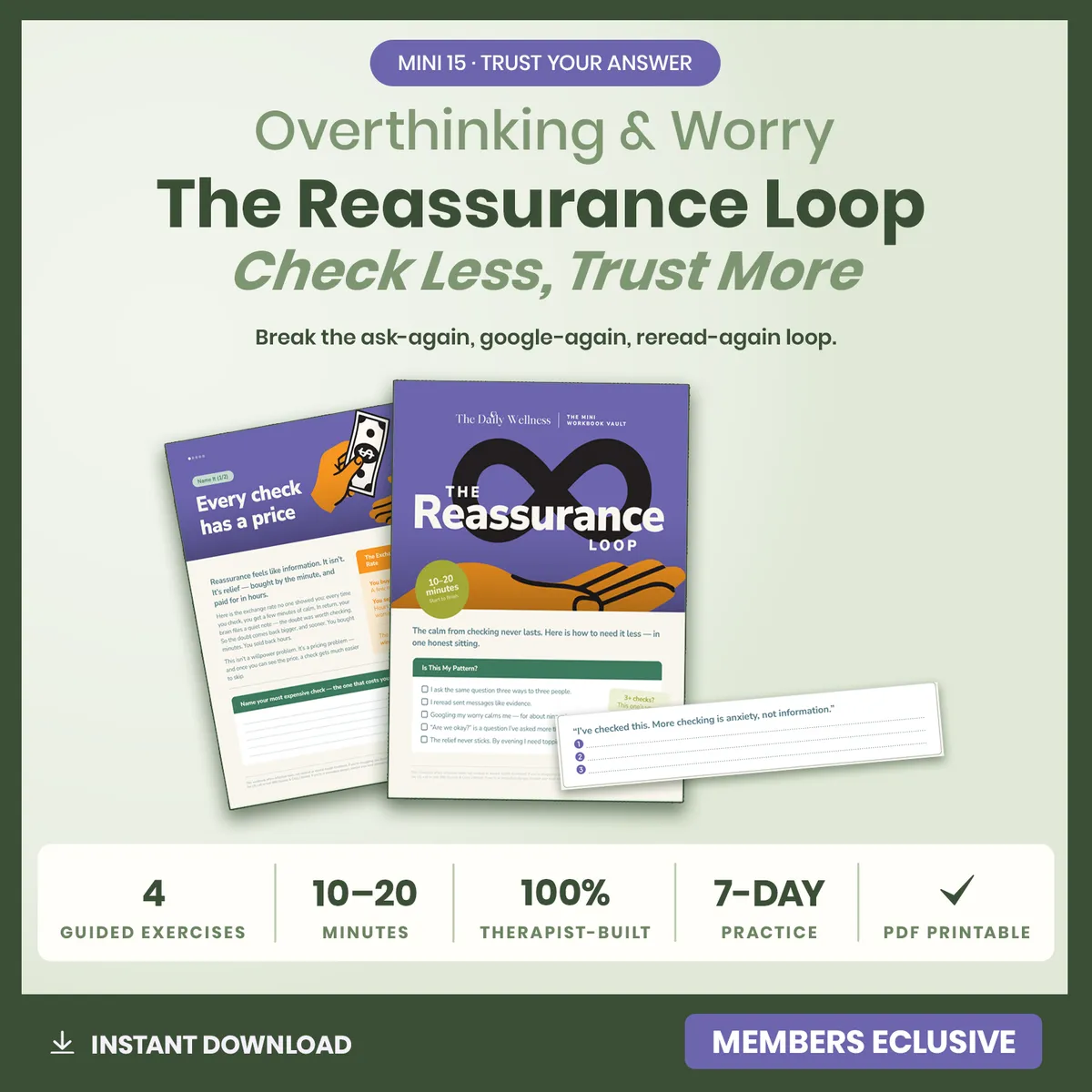
The Reassurance Loop
Use this when: you ask the same question three ways to three people.
Every check buys minutes of relief and sells back hours of doubt. You map who you ask, what you search and what you reread, do the
arithmetic, write your own answers to your top three, and set a taper that halves the checking each week.
COLLECTION 4
Anxiety Patterns
For the fear that keeps redrawing your map smaller.
5 workbooks
WORKBOOK 16
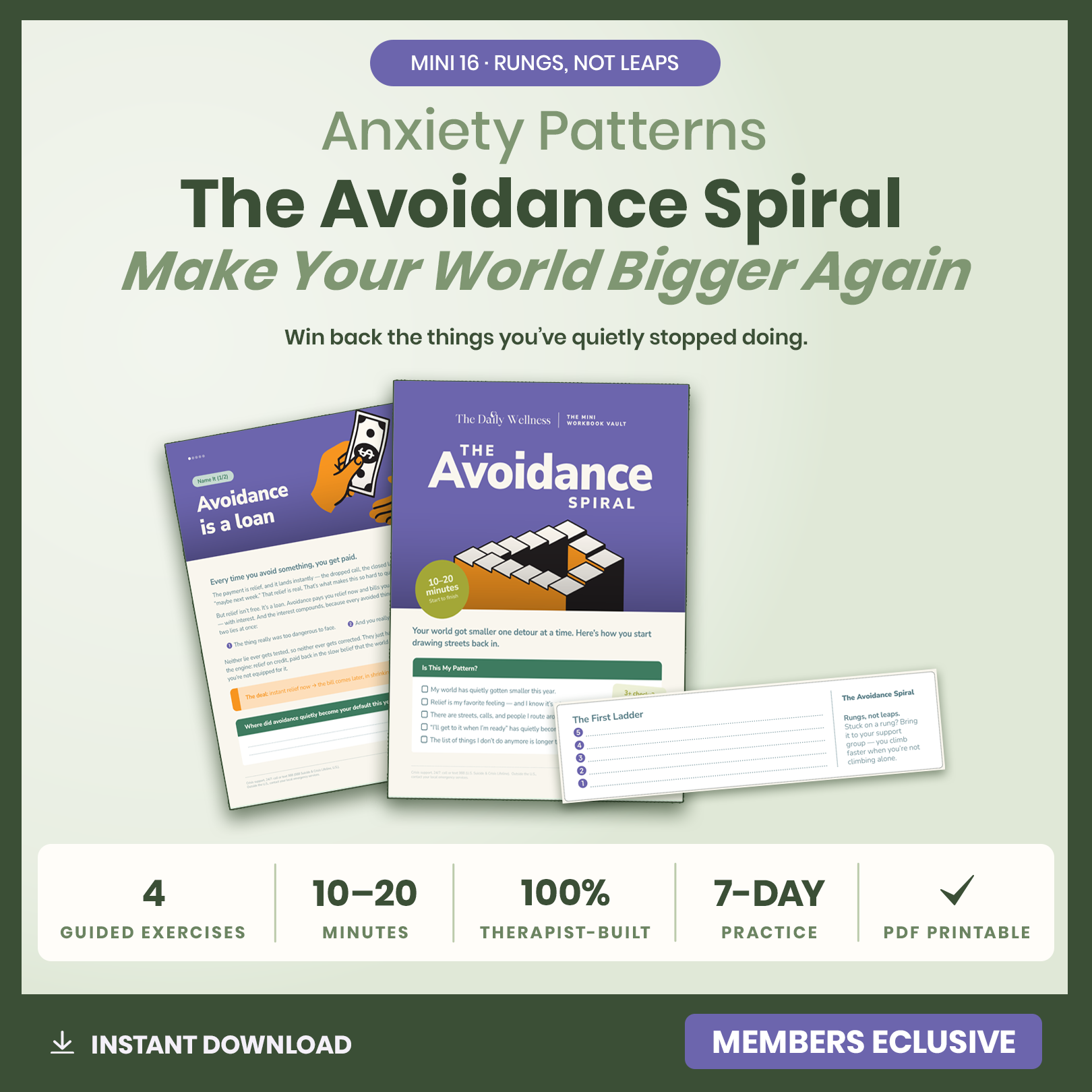
The Avoidance Spiral
Use this when: your world has quietly got
smaller this year.
Avoidance pays relief now and bills confidence later. Every dodge erases a street from your map. You take an honest inventory of what you’ve stopped doing, pick one item, build a five-rung ladder toward it, and schedule rung one before you close the workbook.
WORKBOOK 17
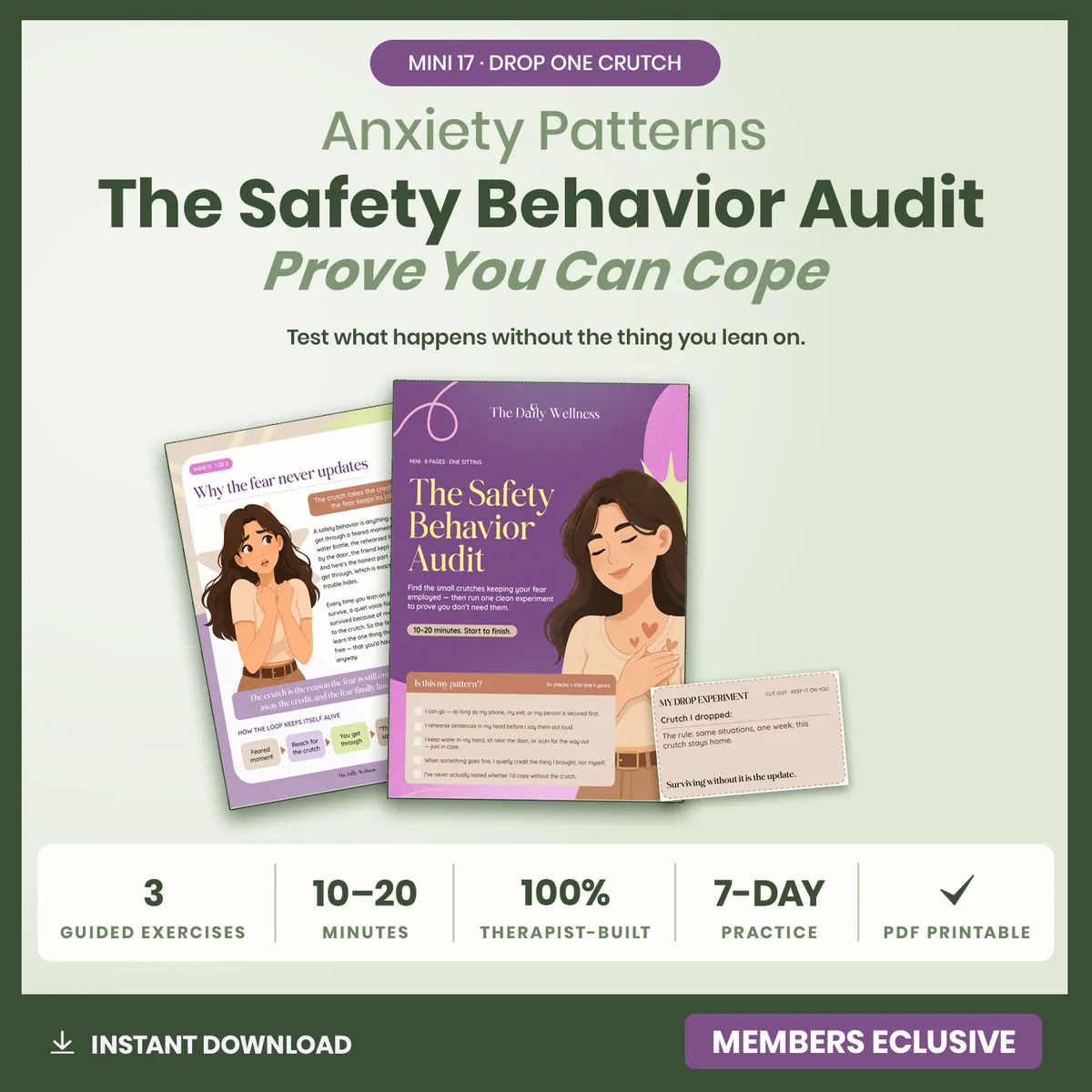
The Safety Behavior Audit
Use this when: you can go, as long as your
phone, exit or person is secured.
A crutch whispers “you survived because of
me,” so the fear never updates. You audit your crutches, tell comfort from crutch (does it carry an “or else”?), and design a one-week experiment dropping just one, with your prediction written down first.
WORKBOOK 18
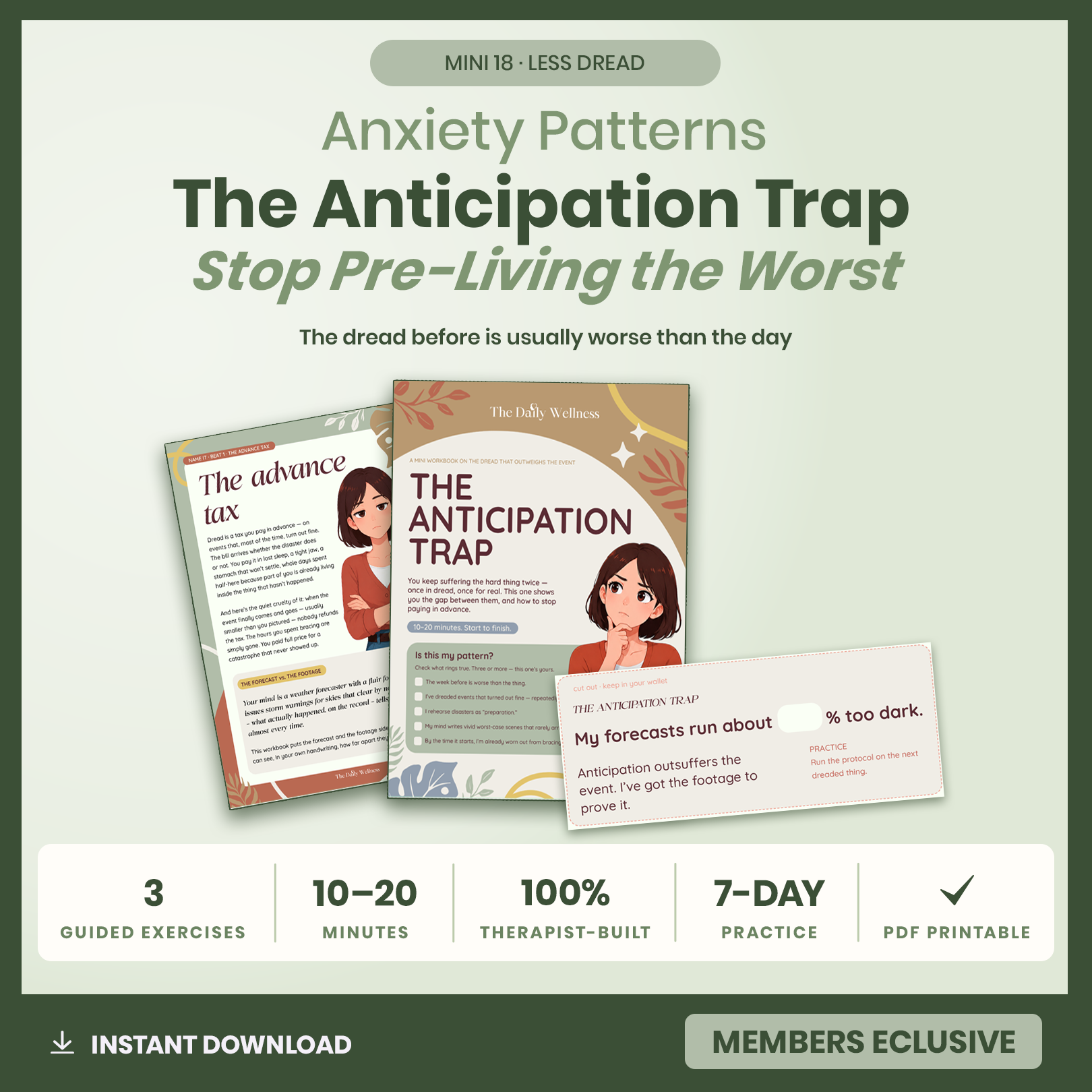
The Anticipation Trap
Use this when: the week before is worse than the thing.
Dread is a tax collected in advance on events
that mostly go fine. You compare forecast with footage for three past events and work out your personal exaggeration rate. Next time, you rehearse only the first two minutes, and check the forecast afterwards.
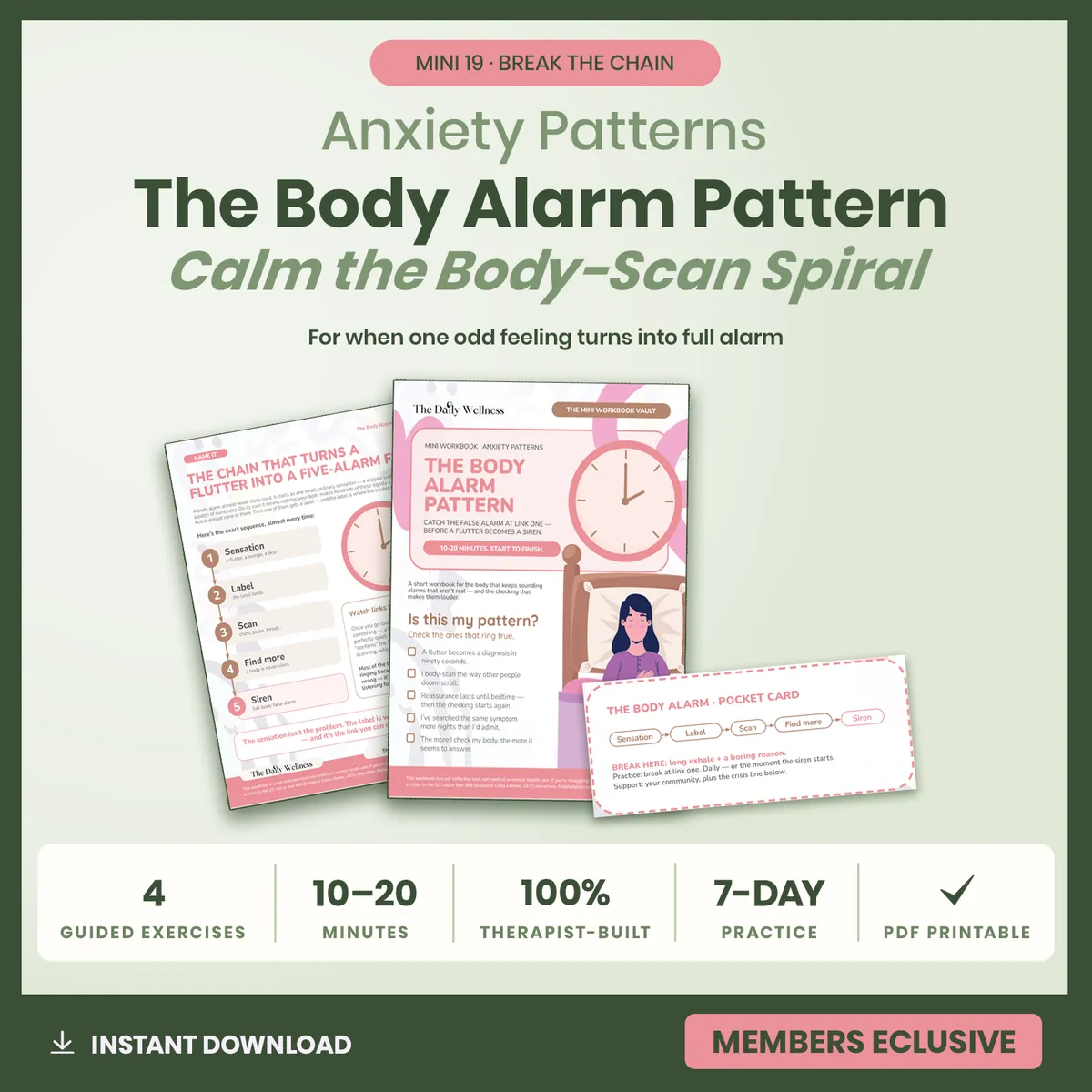
WORKBOOK 19
The Body Alarm Pattern
Use this when: a flutter becomes a diagnosis
in ninety seconds.
Scanning generates the evidence it fears,
because attention makes any body part louder. You map your chain link by link, learn to break it at link one with a long exhale and a boring explanation, and sign the once-rule: new symptoms go to a doctor once, not to a search engine nightly.
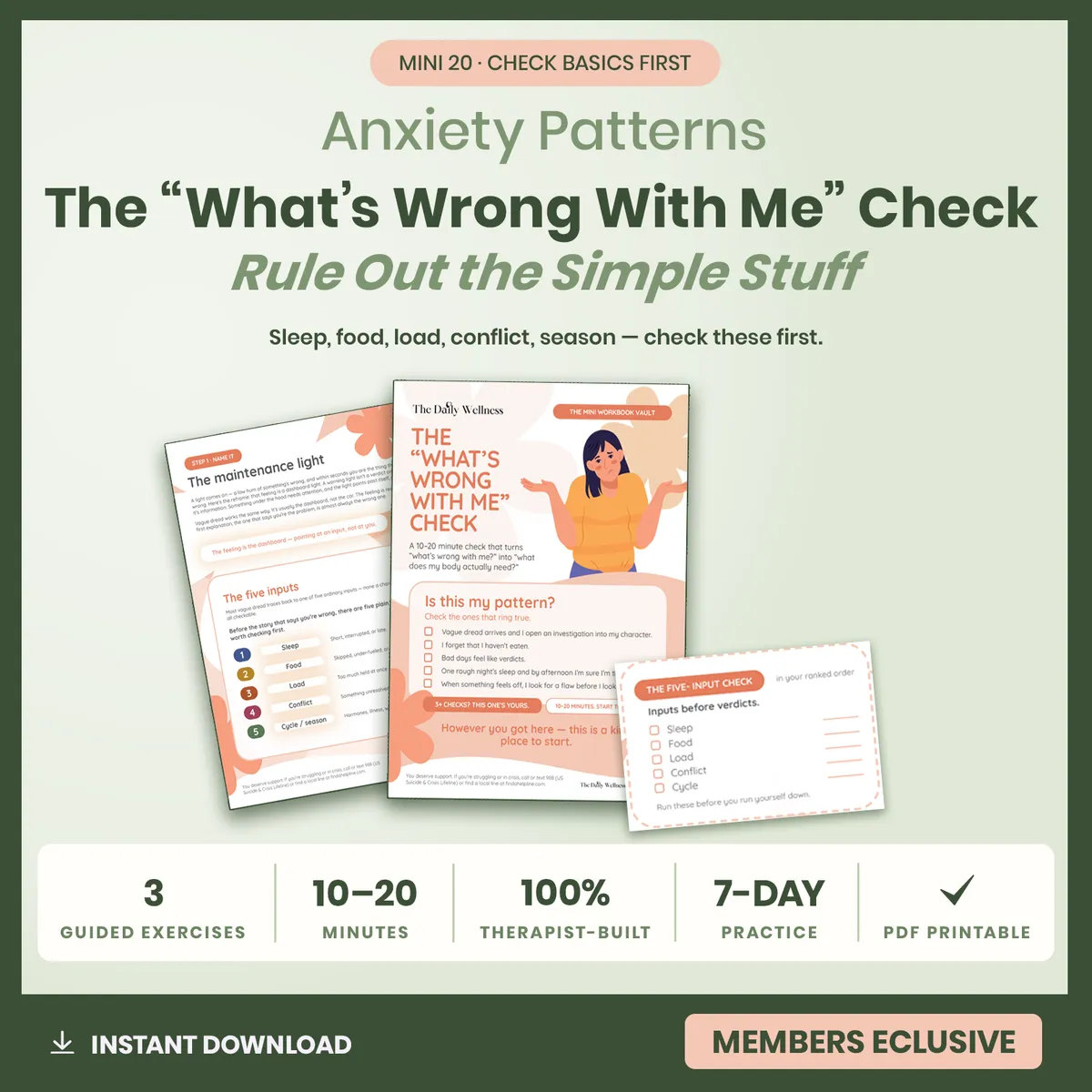
WORKBOOK 20
The “What’s Wrong With Me” Check
Use this when: vague dread arrives and you open an investigation into your character.
Dread is usually the dashboard, not the driver. You run your last three bad days against five inputs (sleep, food, load, conflict, cycle or season), rank your usual culprits, and write one small move for each. Inputs before verdicts.
COLLECTION 5
Mood, Motivation & Stuckness
For the days when everything weighs more.
5 workbooks
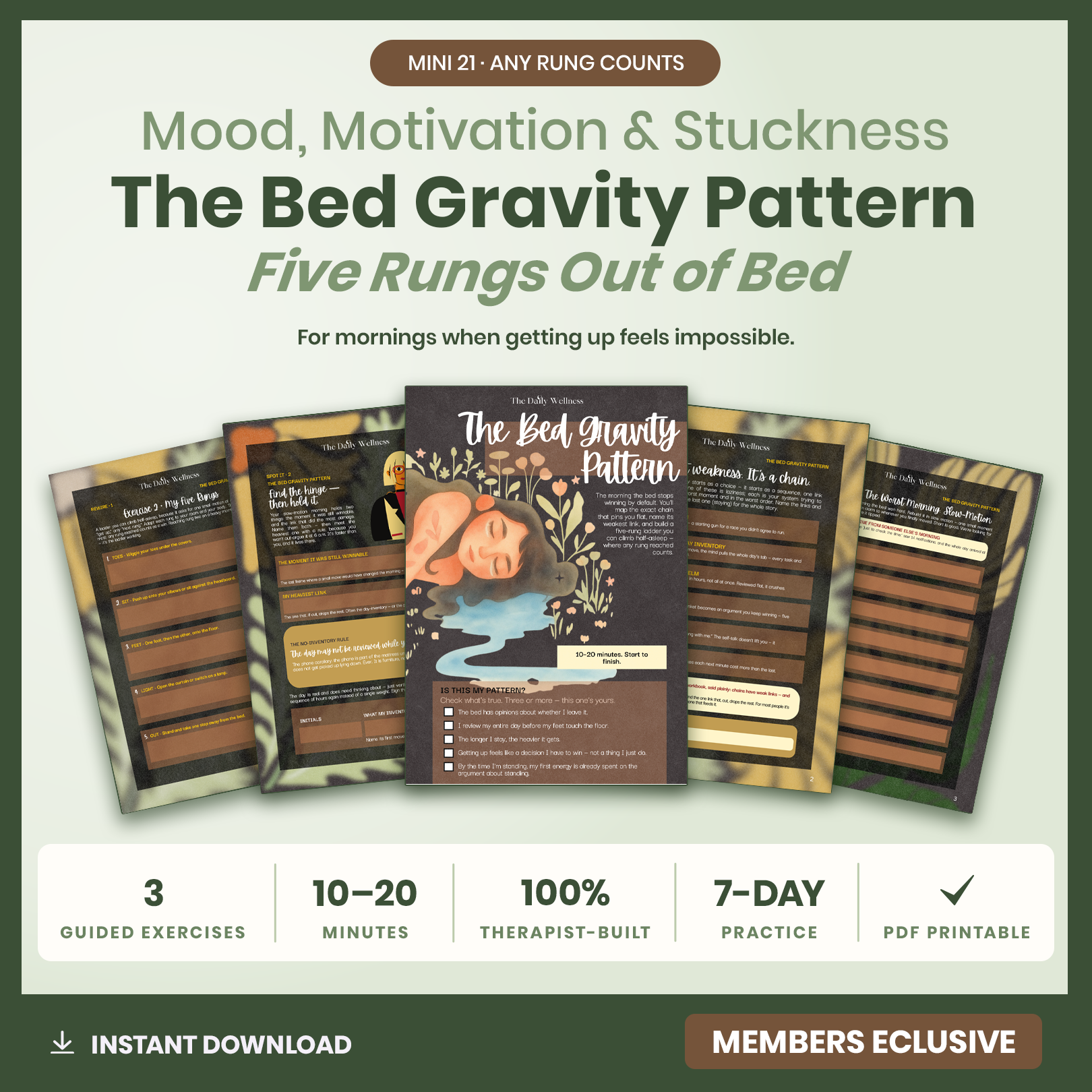
WORKBOOK 21
The Bed Gravity Pattern
Use this when: you review your entire day
before your feet touch the floor.
The longer you stay, the heavier it gets, and the chain has a weak link. You replay your worst morning in slow motion, find the moment it was still winnable, and build a five-rung ladder from toes to out of the room. Any rung counts.
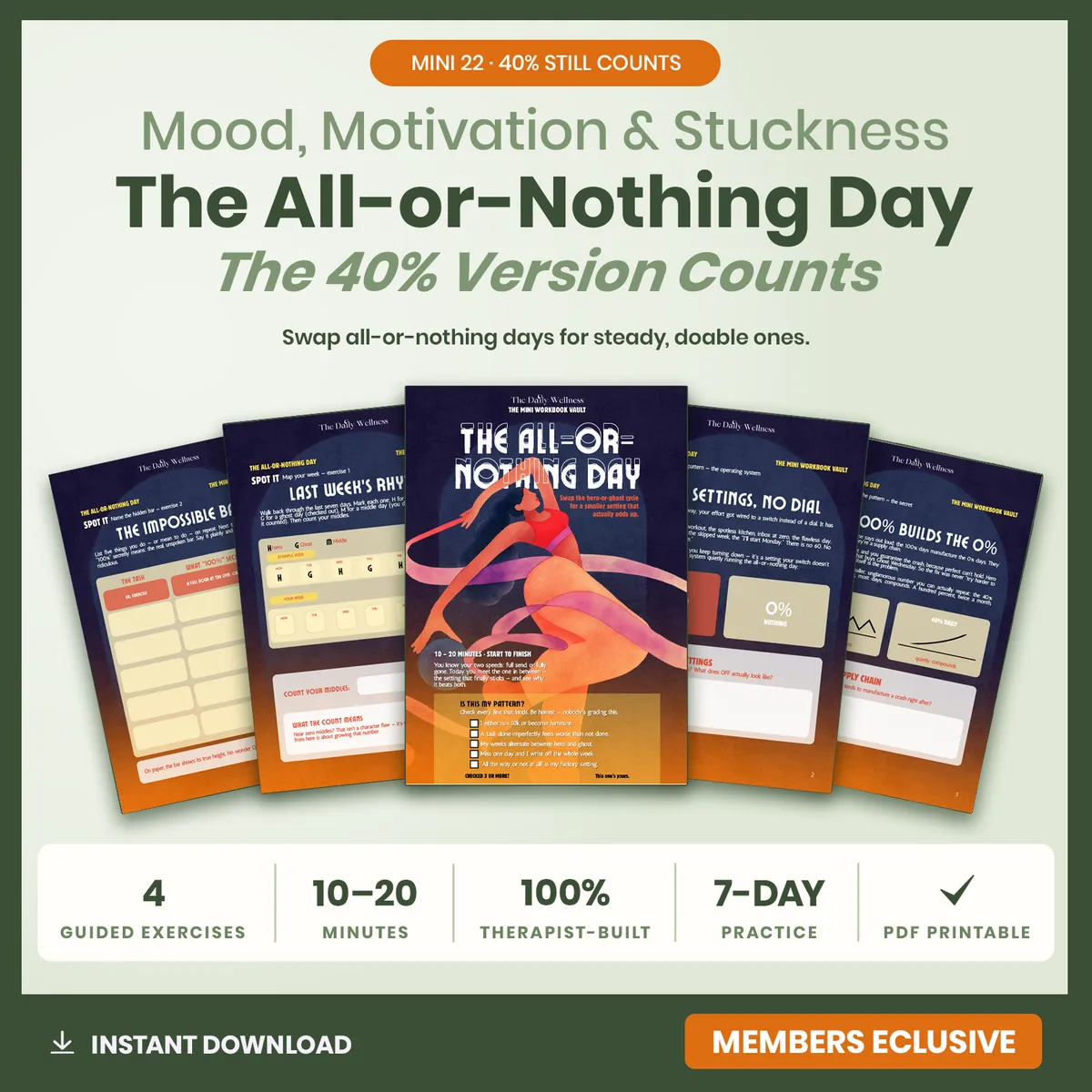
WORKBOOK 22
The All-or-Nothing Day
Use this when: you either run 10k or become furniture.
Your 100 percent days manufacture your zero days. You audit last week for hero days, ghost days and middles (usually none), then define the 40 percent version of five key tasks. A ten-minute walk counts. Consistent at 40 beats heroic at 100.
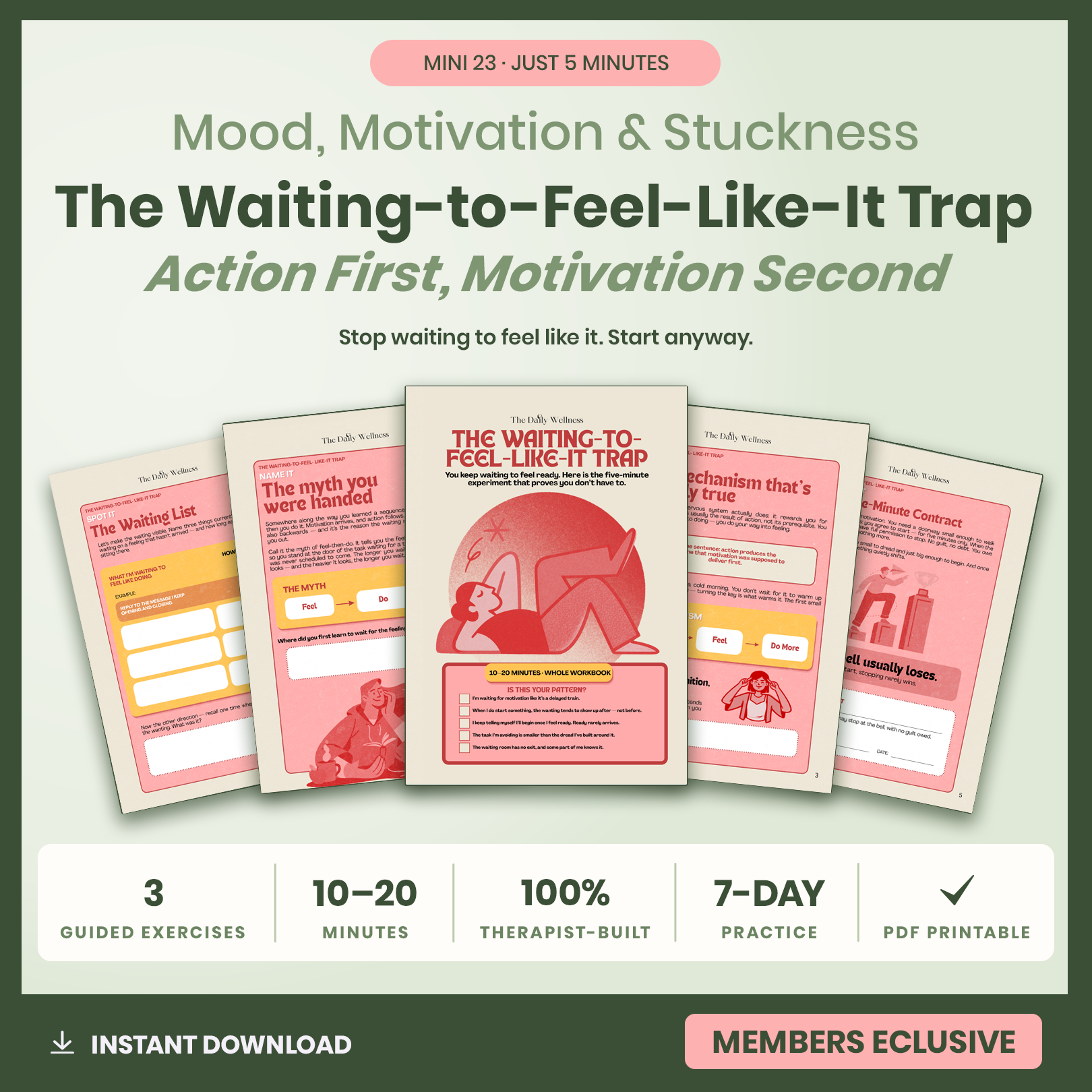
WORKBOOK 23
The Waiting-to-Feel-Like-It
Trap
Use this when: you’re waiting for motivation like it’s a delayed train.
Action produces the motivation you were
waiting to feel first. This mini proves it live: you rate your motivation, the workbook tells you to go do five timed minutes of the thing, and you come back and rate it again. Your own numbers go on the card.
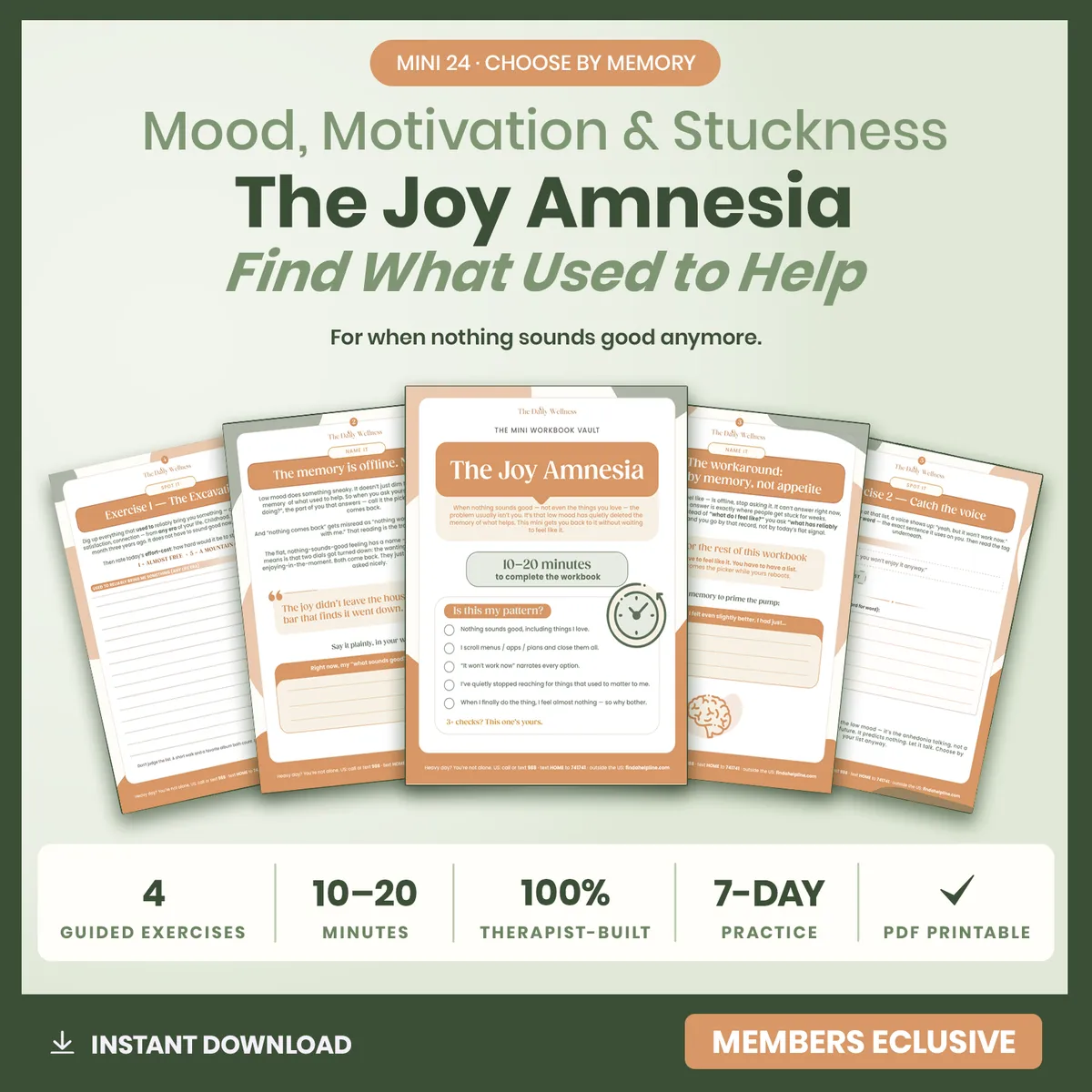
WORKBOOK 24
The Joy Amnesia
Use this when: nothing sounds good,
including the things you love.
Low mood deletes the memory of what helps. The picker is offline; you’re not broken. You dig up everything that used to bring something, rank it by effort, and schedule the two cheapest at half effort, choosing by memory, not appetite.
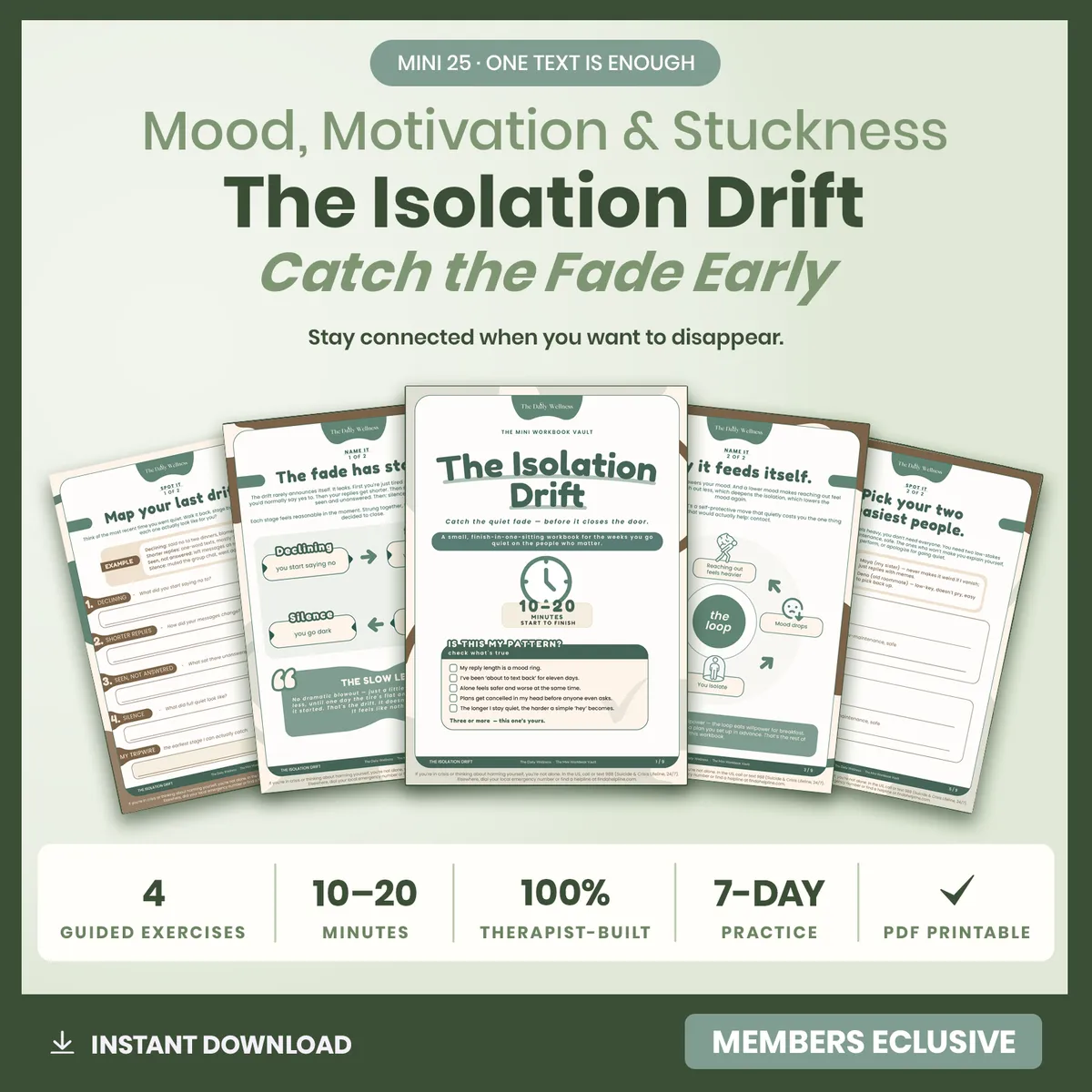
WORKBOOK 25
The Isolation Drift
Use this when: you’ve been “about to text back” for eleven days.
Replies get shorter, then stop, and reaching out gets heavier the longer you wait. You map your own fade, find your tripwire stage,
and pre-write the one text you’ll send when it trips: “low battery lately, not gone. Wave back?” It also says when to tell a professional.
COLLECTION 6
Anger, Shame & Guilt
For the feelings that arrive at a ten.
4 workbooks
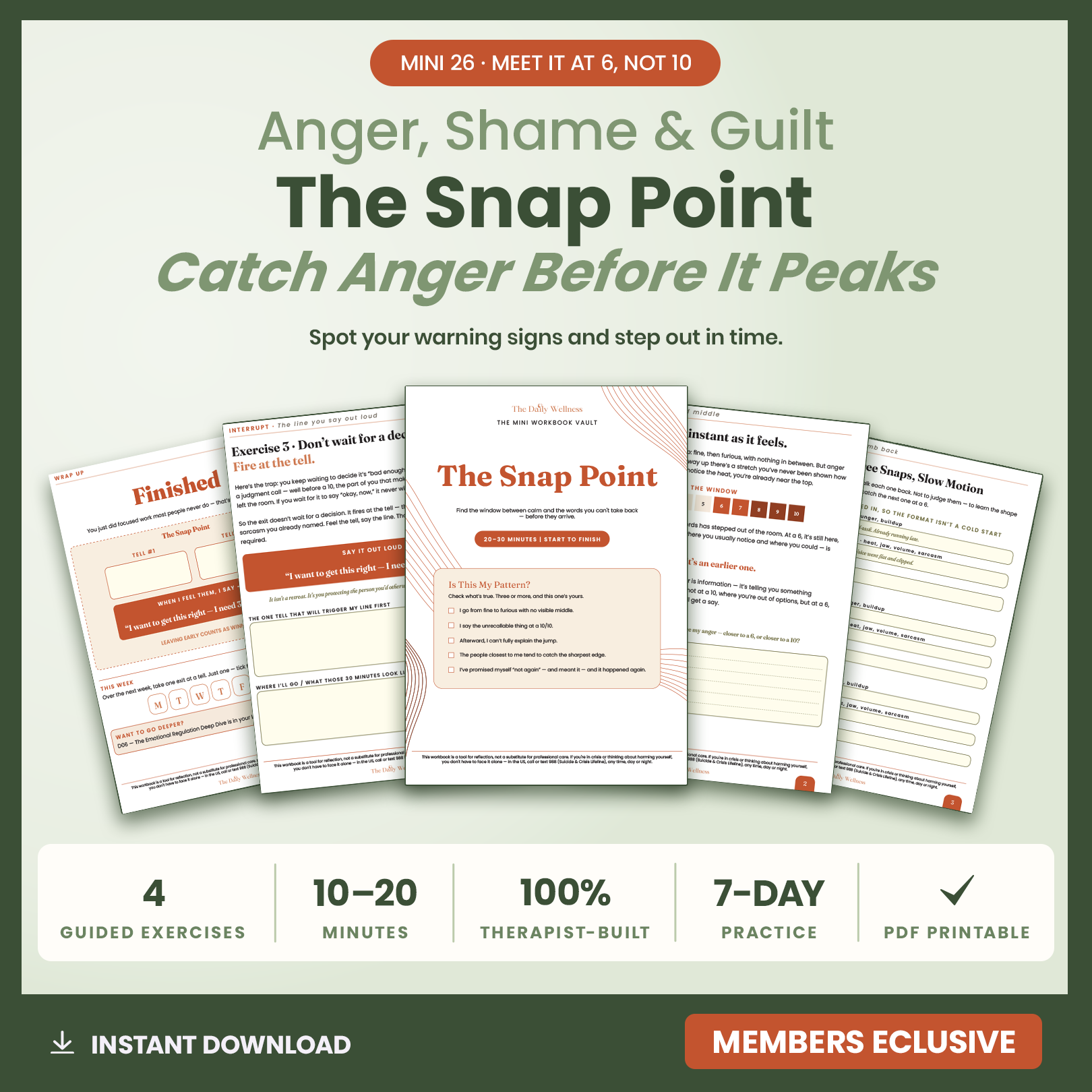
WORKBOOK 26
The Snap Point
Use this when: you go from fine to furious
with no visible middle.
The jump feels instant, but there’s a window at six out of ten where choice still lives. You replay three snaps in slow motion to find your body’s tells, then install one exit line that fires at the tells: “I want to get this right. I need 30 minutes.”
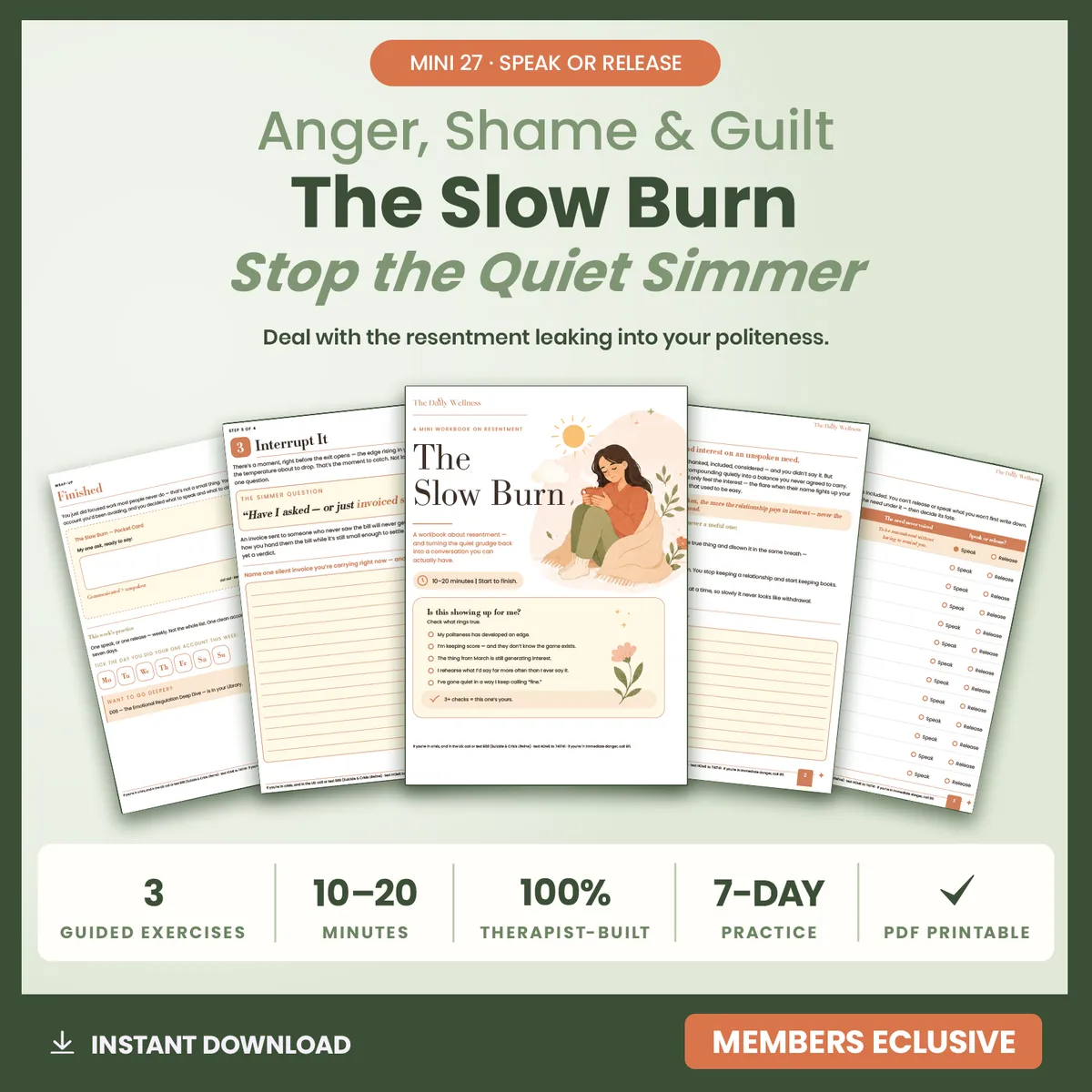
WORKBOOK 27
The Slow Burn
Use this when: your politeness has developed an edge.
Resentment is compound interest on needs you never voiced, and it leaks out as sarcasm,
scorekeeping and the chill. You inventory every simmer, decide speak or release for each, and leave with one conversation drafted and one grudge formally retired.
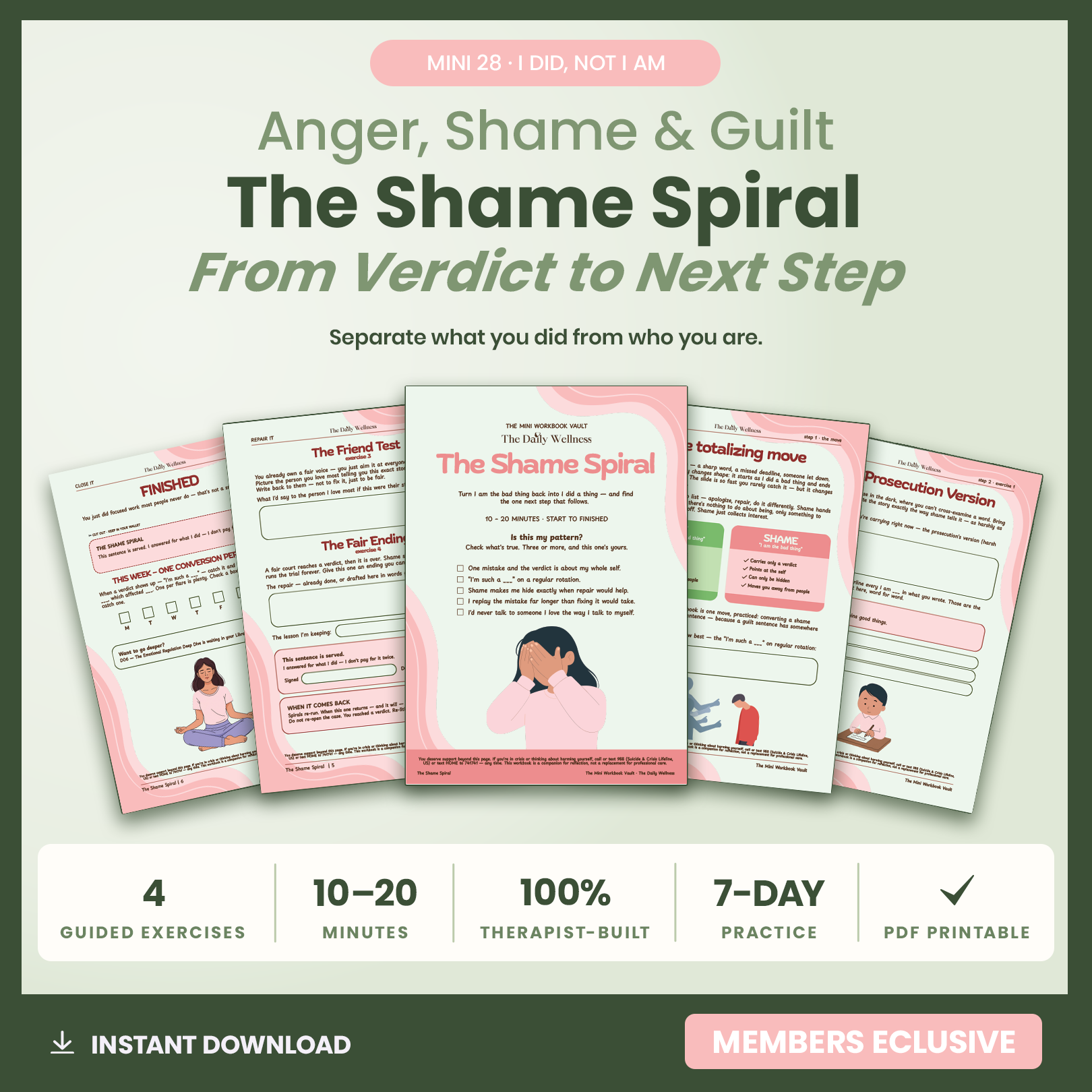
WORKBOOK 28
The Shame Spiral
Use this when: one mistake becomes a
verdict on your whole self.
Guilt carries a to-do list. Shame carries only a
verdict. You write the story as your inner
prosecutor tells it, convert every “I am” into “I did, which affected,” and write the fair ending: repair made, lesson kept, sentence served.
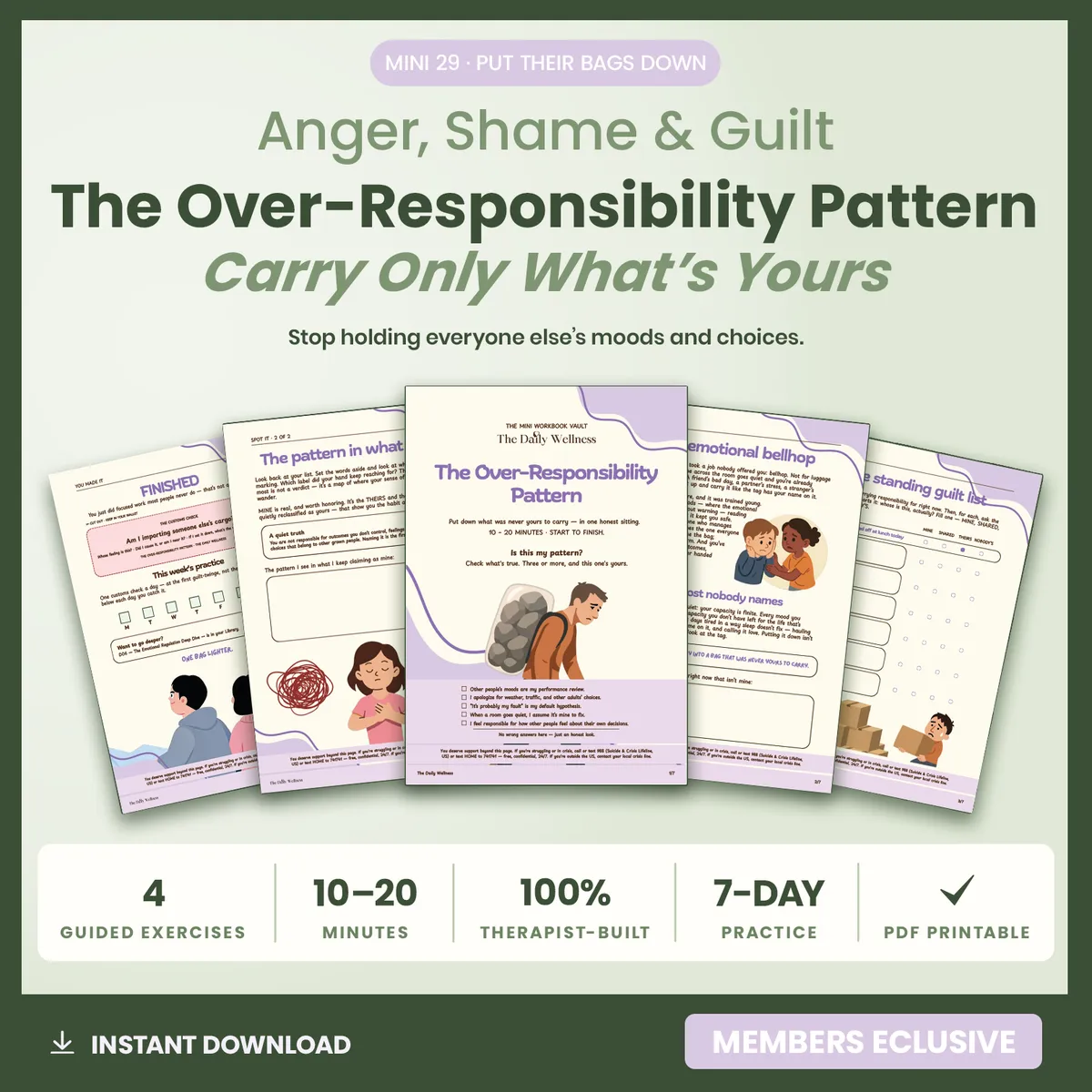
WORKBOOK 29
The Over-Responsibility Pattern
Use this when: other people’s moods feel like your performance review.
You’ve been working as an emotional bellhop, carrying cargo with someone else’s name on it. You list everything you feel responsible for, sort it (mine, shared, theirs, nobody’s), formally return three items in writing, and keep only your actual part.
That’s the first 29 workbooks.
Relationships, self-sabotage, burnout, sleep, social anxiety and life transitions are next. Or skip ahead:
COLLECTION 7
Relationships & Attachment Patterns
For the moves you make when people get close.
5 workbooks

WORKBOOK 30
The Anxious Text Loop
Use this when: delivered-not-read is a
psychological event.
Send, watch, decode, spiral. Their reply speed measures their day, not your worth. You autopsy one real thread, count the checks, park the phone in a named spot, and write a five item plan for what you’ll do in the gaps.
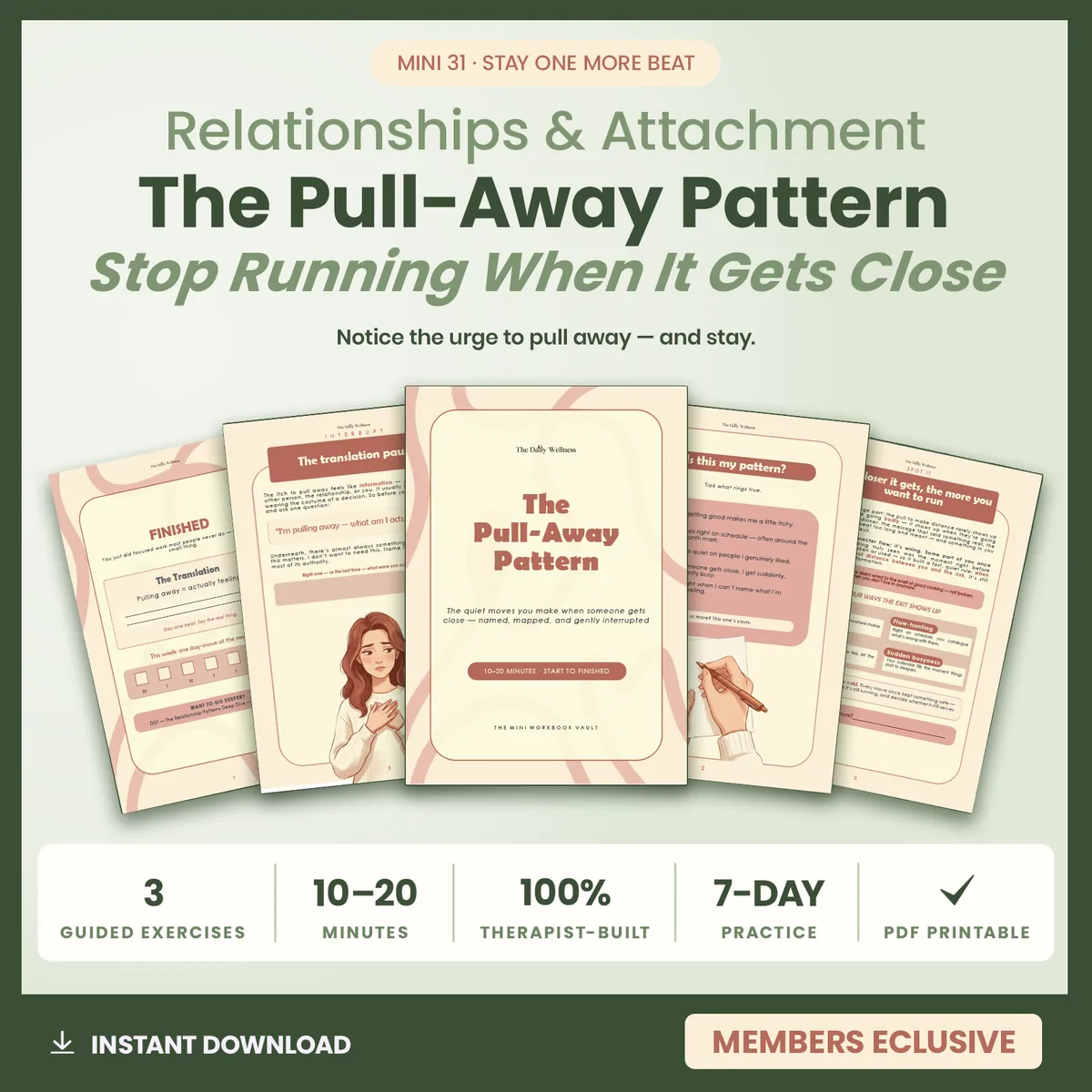
WORKBOOK 31
The Pull-Away Pattern
Use this when: things getting good makes you itchy.
As closeness rises, old wiring reads it as
exposure and fires a distance move: the picked fight, the sudden flaw, the quiet. No shame here; the wiring once protected something. You find your signature moves and design one small stay-move for the next itch.
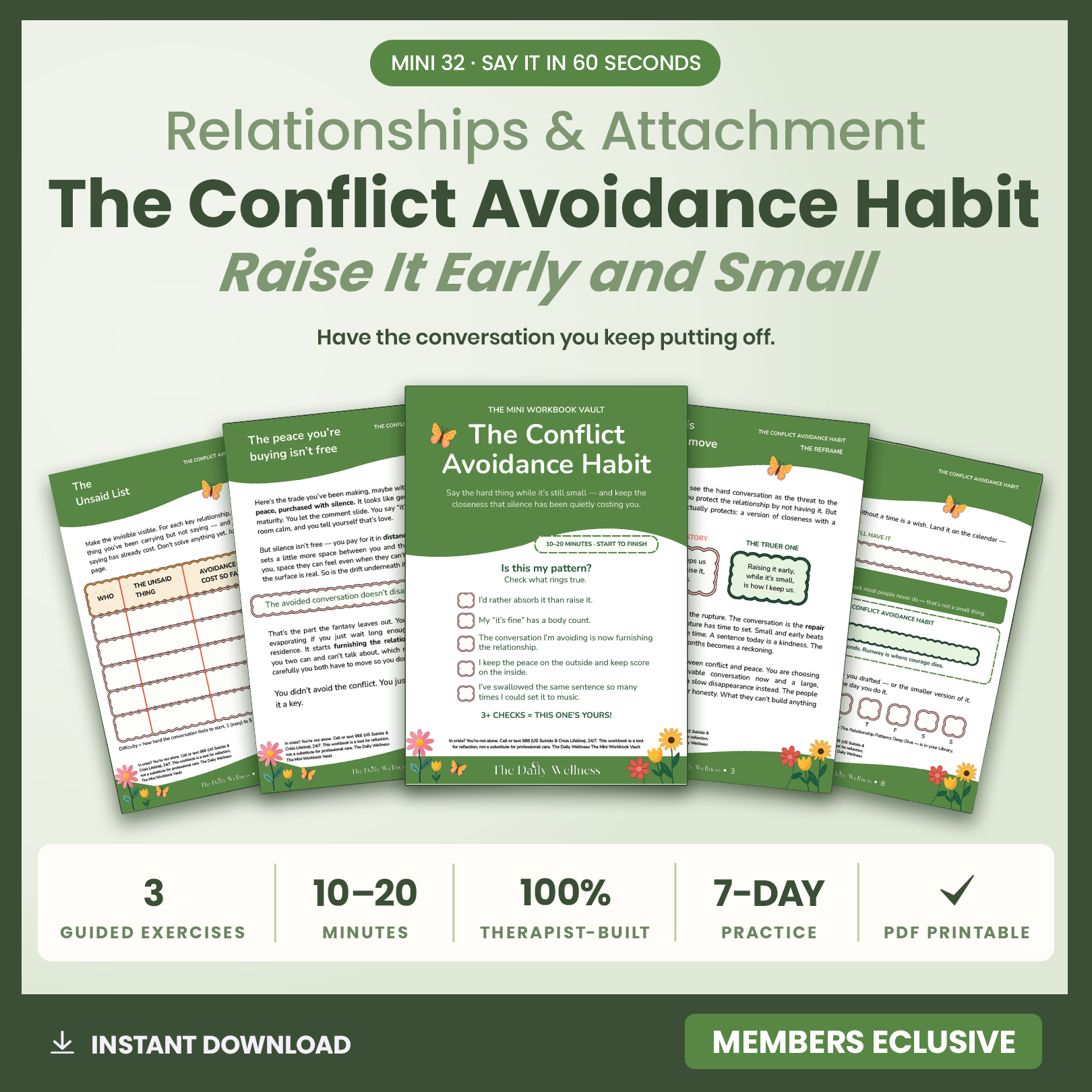
WORKBOOK 32
The Conflict Avoidance Habit
Use this when: you’d rather absorb it than
raise it.
Peace bought with silence gets paid for in
distance, and the avoided conversation doesn’t leave, it moves in. You list the unsaid things, pick the one with the best cost-to-difficulty ratio, and draft it in full: opener, ask, their likely reply, your second line.
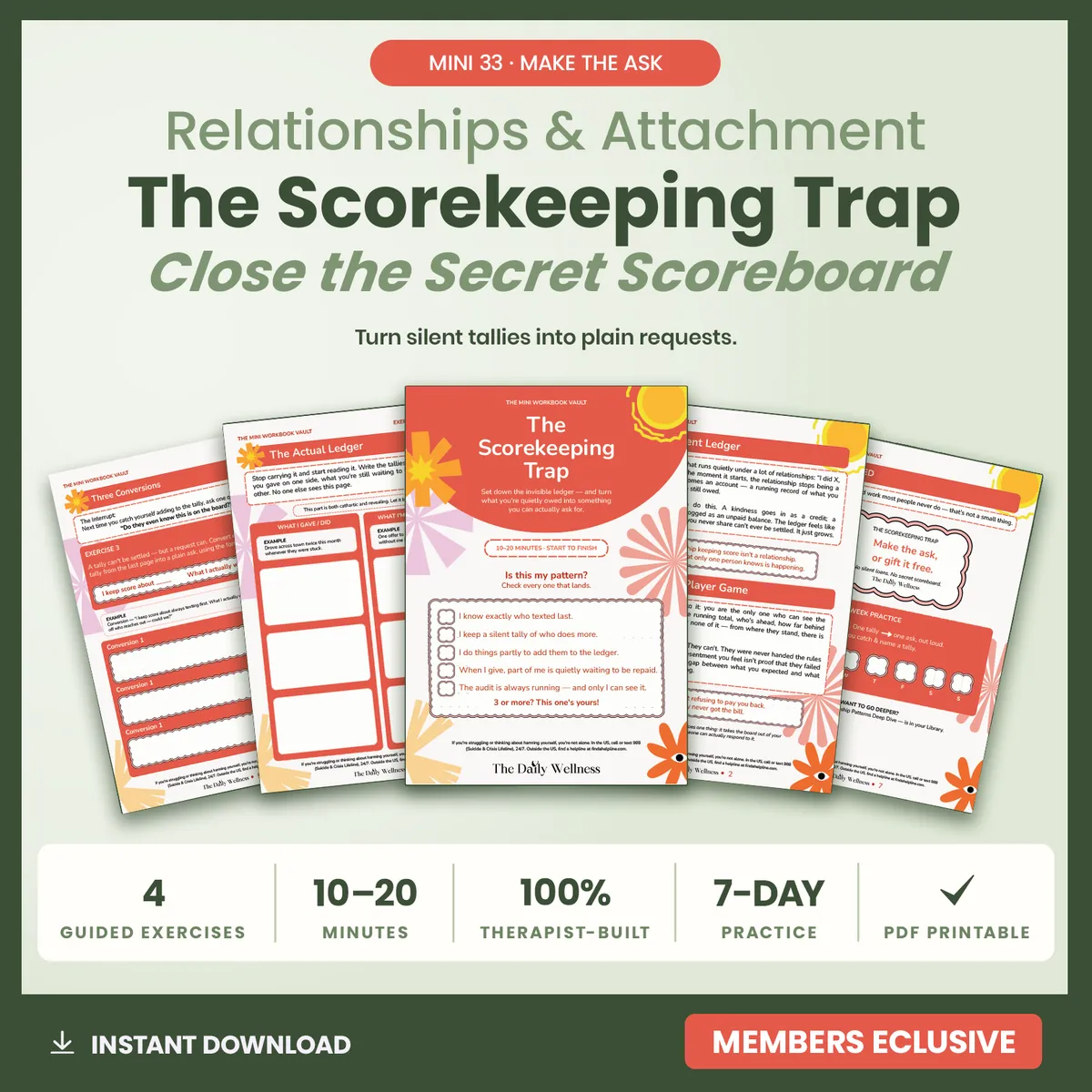
WORKBOOK 33
The Scorekeeping Trap
Use this when: you know exactly who texted last.
Only you can see the scoreboard, so the other player doesn’t know they’re losing. You write the actual ledger, find the unspoken expectation inside your top three tallies, and convert each into a plain request. The tally retires when the ask is made.
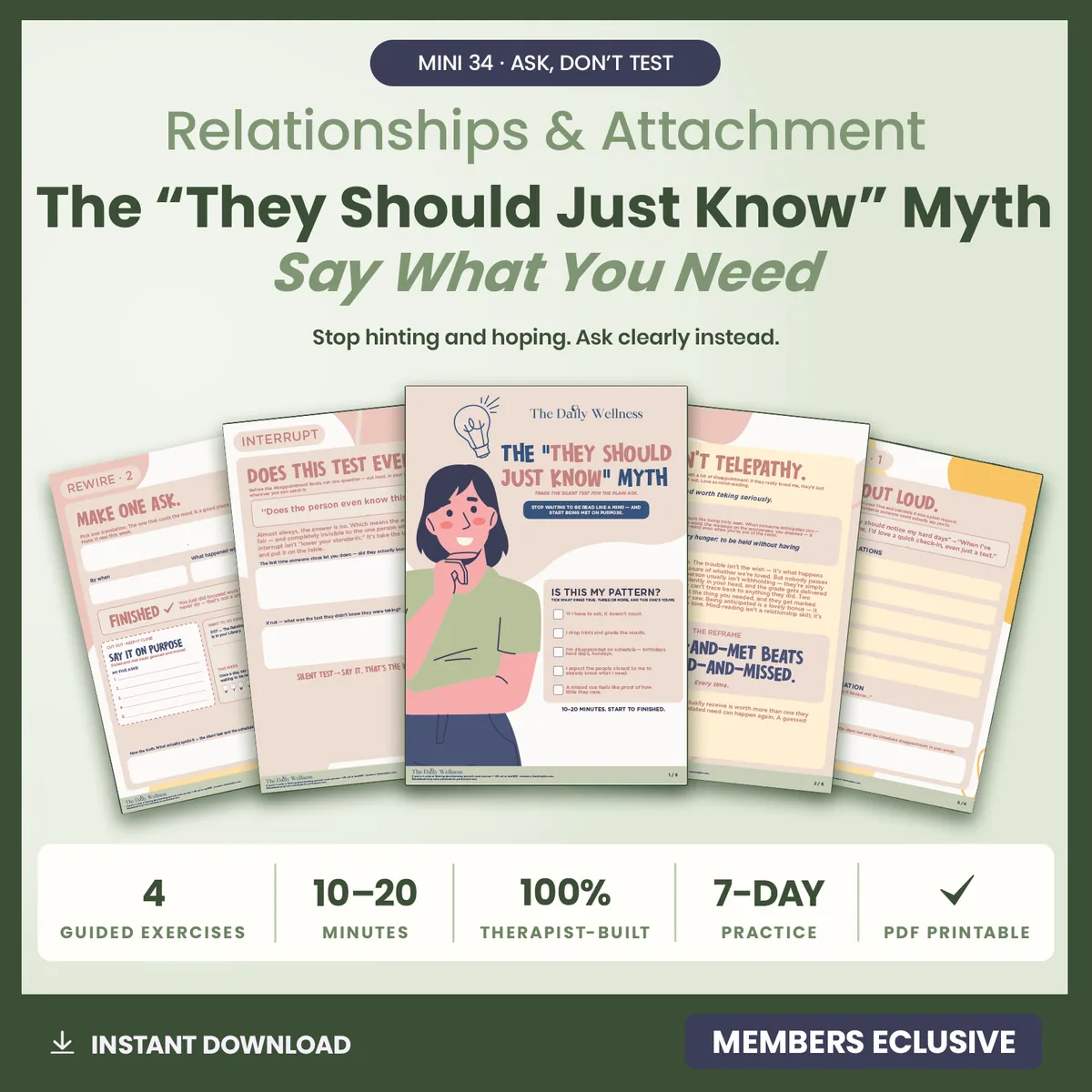
WORKBOOK 34
The “They Should Just Know” Myth
Use this when: if you have to ask, it doesn’t count.
Nobody passes a test they don’t know they’re taking. You write down your five unspoken expectations and the disappointment each keeps producing, translate every one into an explicit ask, and choose one to make this week. Stated-and-met beats guessed-and missed.
COLLECTION 8
Self-Sabotage & Habits
For the thing you do right before it goes well.
5 workbooks
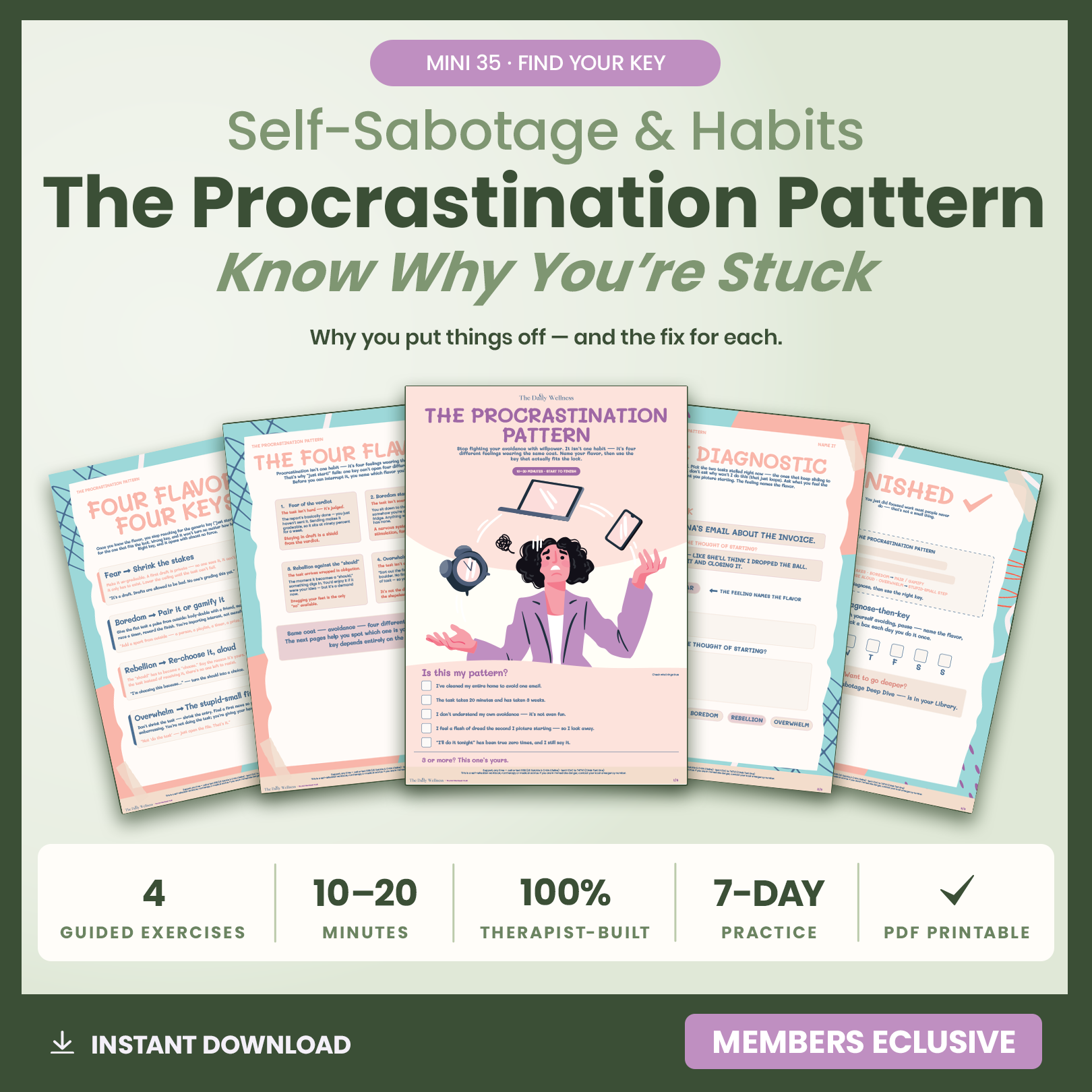
WORKBOOK 35
The Procrastination Pattern
Use this when: you’ve cleaned your whole
home to avoid one email.
“Just start” fails because procrastination comes in four flavors: fear of the verdict, boredom, rebellion and overwhelm. You diagnose two stalled tasks, match each flavor to its key, and start one for five timed minutes before the workbook ends.
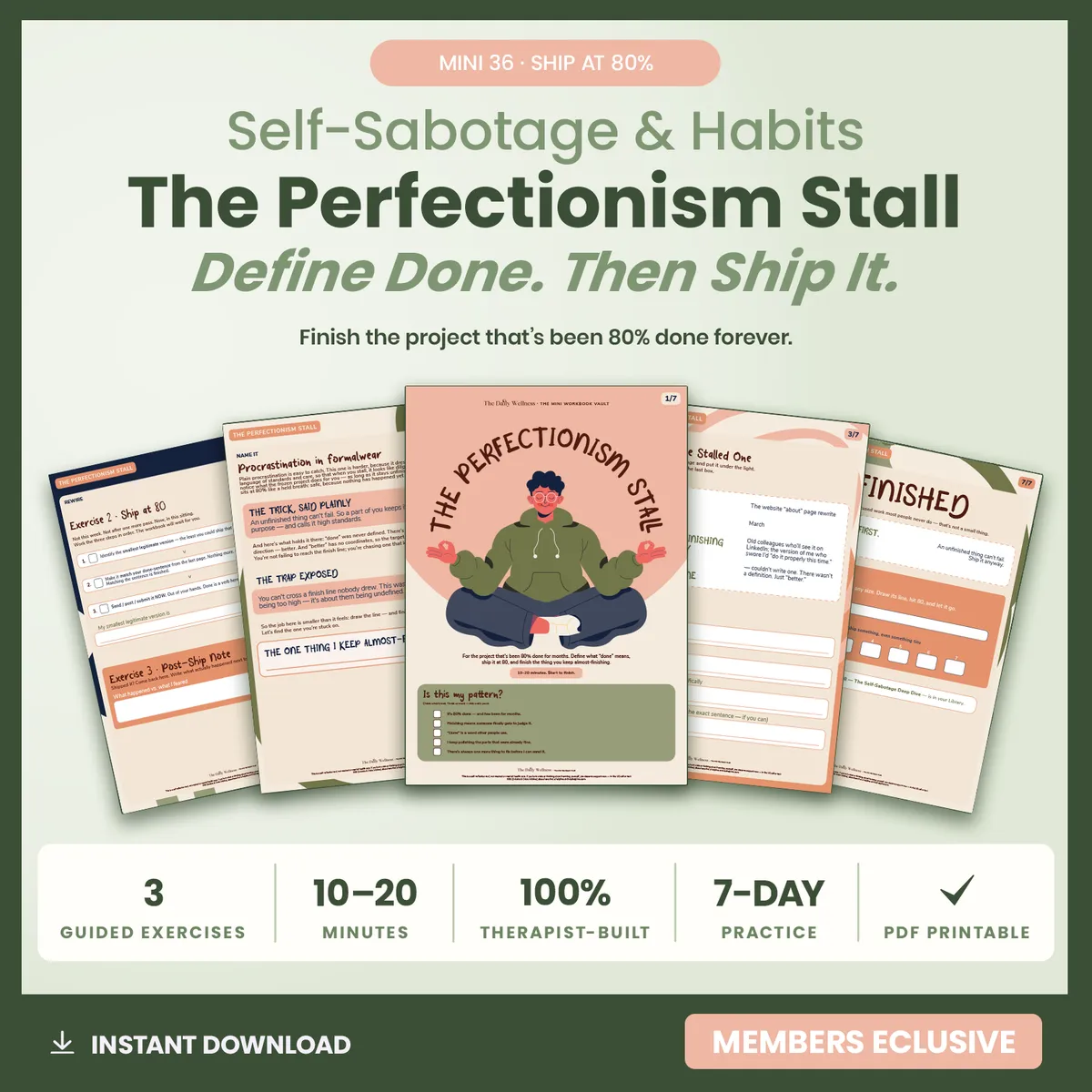
WORKBOOK 36
The Perfectionism Stall
Use this when: it’s 80 percent done and has
been for months.
Perfectionism is procrastination in formalwear. An unfinished thing can’t be judged. You name whose verdict you’re dodging, define “done” in one sentence, and ship the smallest legitimate version during the sitting. The workbook waits while you press send.
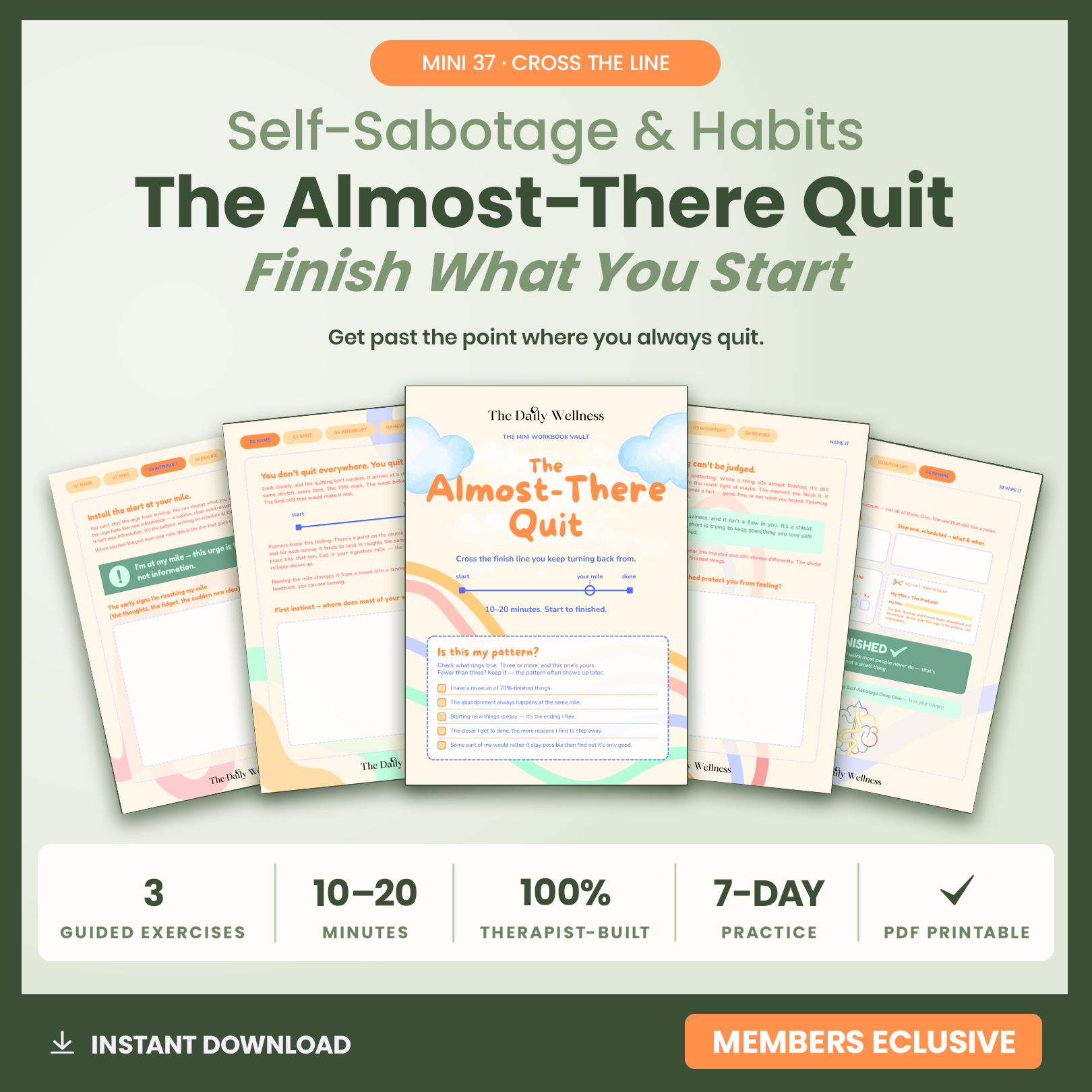
WORKBOOK 37
The Almost-There Quit
Use this when: you have a museum of 70-
percent-finished things.
Everyone abandons at a signature mile, and the quit protects you from the verdict. You tour your museum, find your mile, and learn the alert: “This urge is the pattern, not
information.” Then you pick one piece to
resurrect and shrink what’s left to three steps.
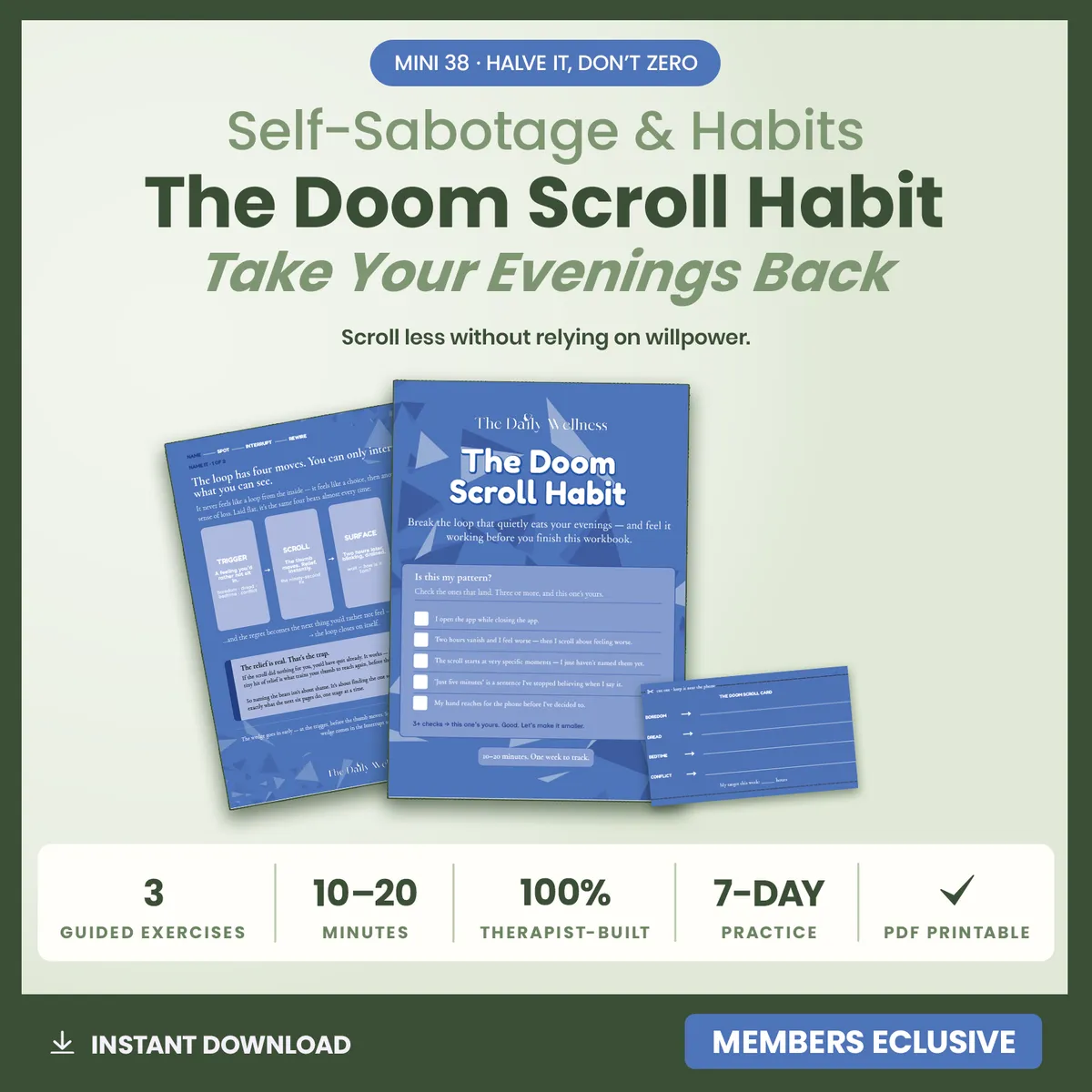
WORKBOOK 38
The Doom Scroll Habit
Use this when: you open the app while
closing the app.
It’s you against a thousand engineers, so you
change the arena. You audit when the scrolls
start and what they numb, then add friction
during the sitting: apps off the home screen,
one deleted, a parking spot for the phone
overnight. The target is halved, never zero.
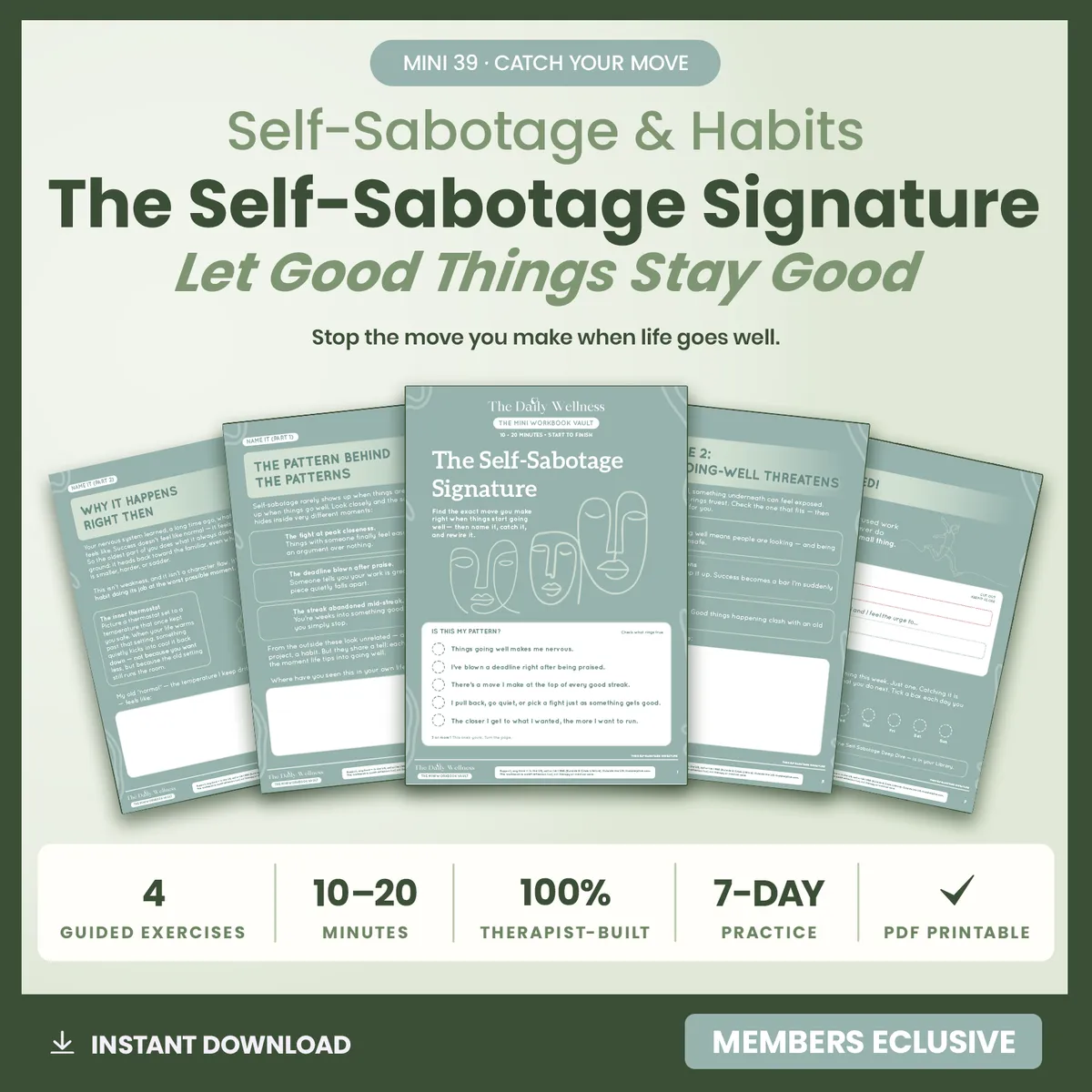
WORKBOOK 39
The Self-Sabotage Signature
Use this when: things going well makes you nervous.
There’s a move you make at the top of every good streak, because success is unfamiliar and old wiring runs toward the known. You
study three good things gone wrong, find the common move and its timing, and pre-commit the opposite action for next time.
COLLECTION 9
Stress, Burnout & Overload
For the plate nobody chose and everybody filled.
4 workbooks
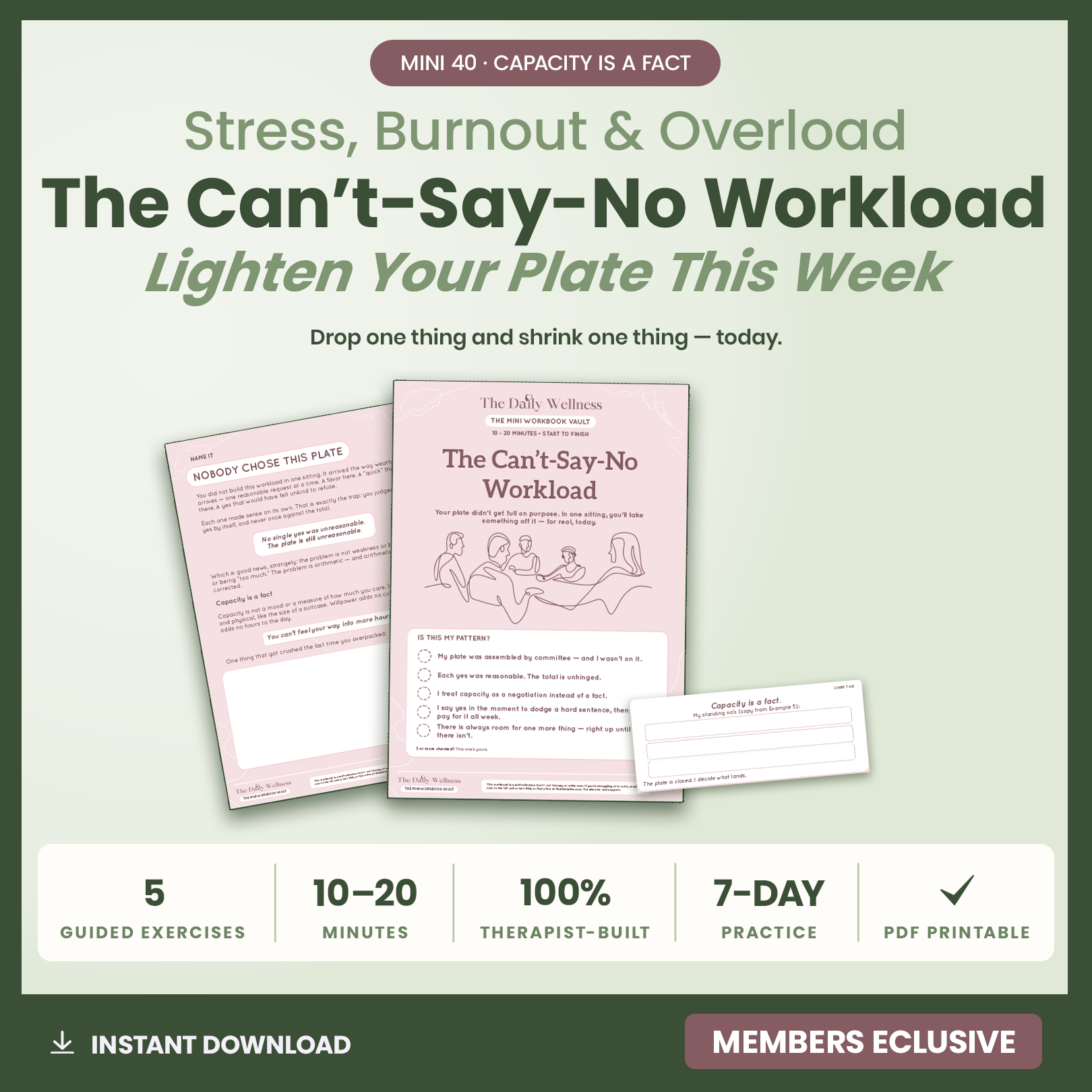
WORKBOOK 40
The Can’t-Say-No Workload
Use this when: each yes was reasonable and
the total is unhinged.
Capacity is a fact, like the size of a suitcase.
Feelings don’t expand it. You list the full plate, invisible labor included, mark what’s droppable, and drop one item during the sitting with the message drafted. You leave with a standing-no list.
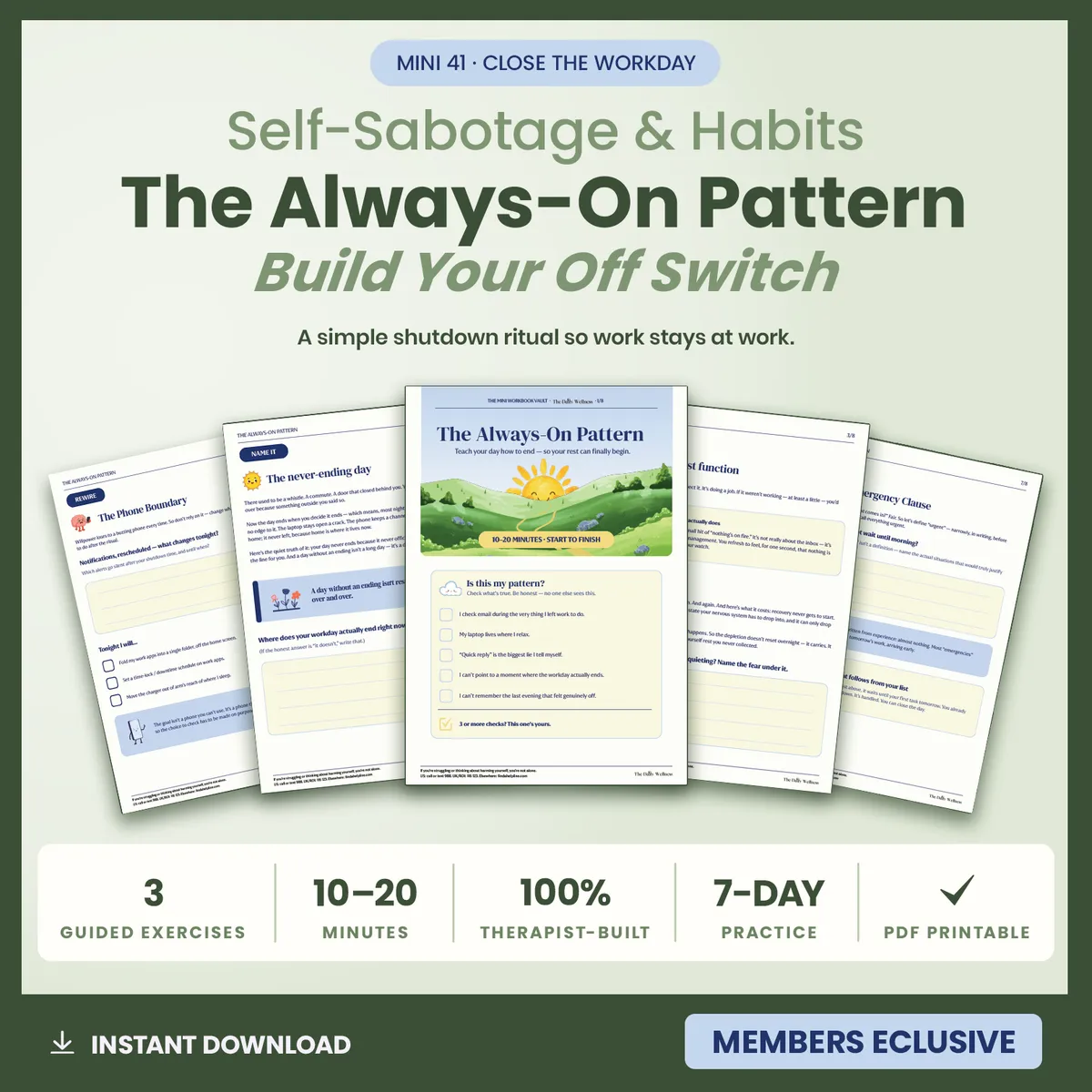
WORKBOOK 41
The Always-On Pattern
Use this when: you check email during the
thing you left work to do.
The day never ends because it never officially ends. You map your checking habits, then design a shutdown ritual: a fixed time, tomorrow’s first task written, open loops parked on paper, the laptop closed and shelved. Plus a narrow definition of a real emergency.
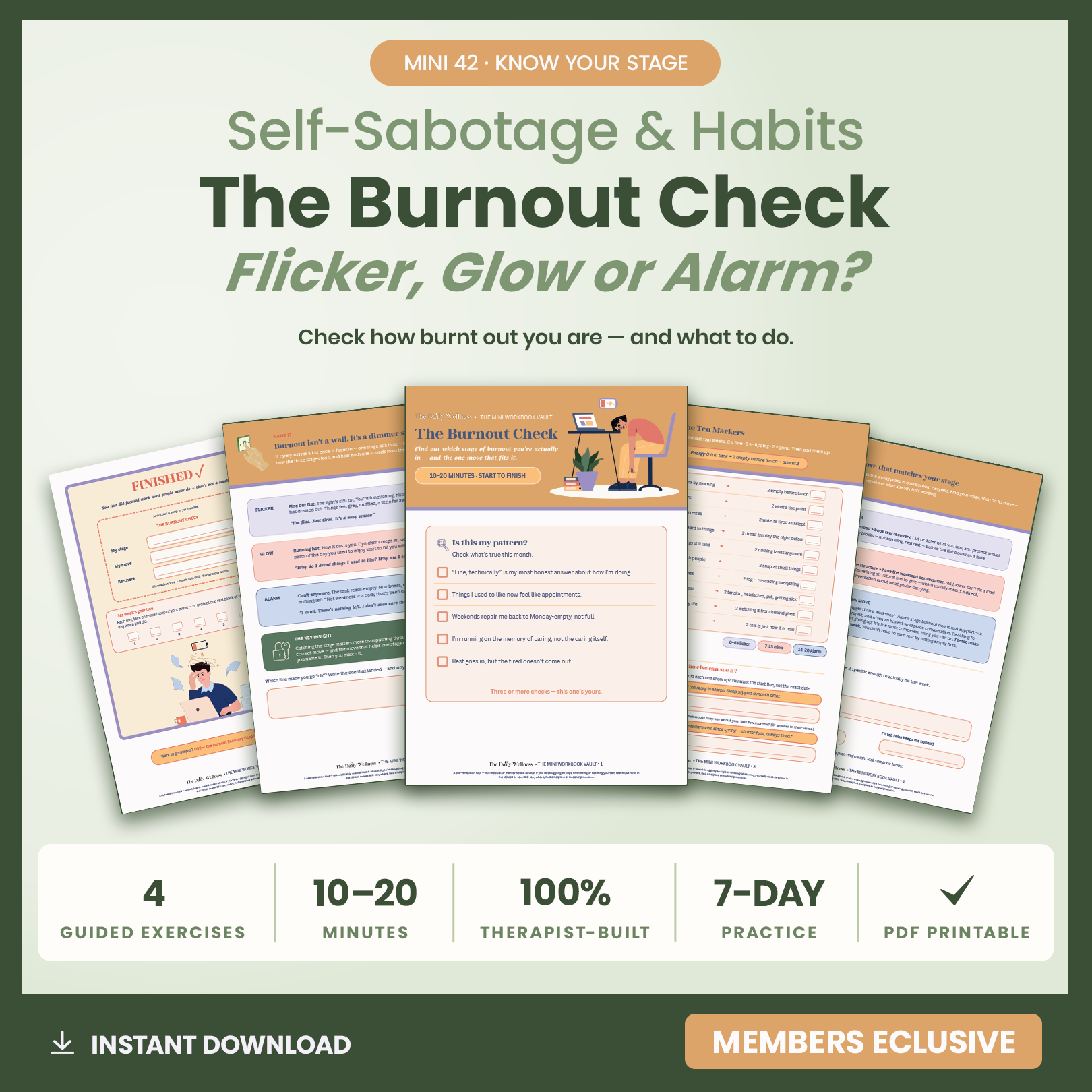
WORKBOOK 42
The Burnout Check
Use this when: you’re fine, technically.
Burnout has stages: flicker, glow, alarm. Each
needs a different move. You score ten markers, find your stage, and commit to its move in writing, with a date and a person told. At the alarm stage the workbook says it plainly: this is beyond worksheets, and professional support is the move.
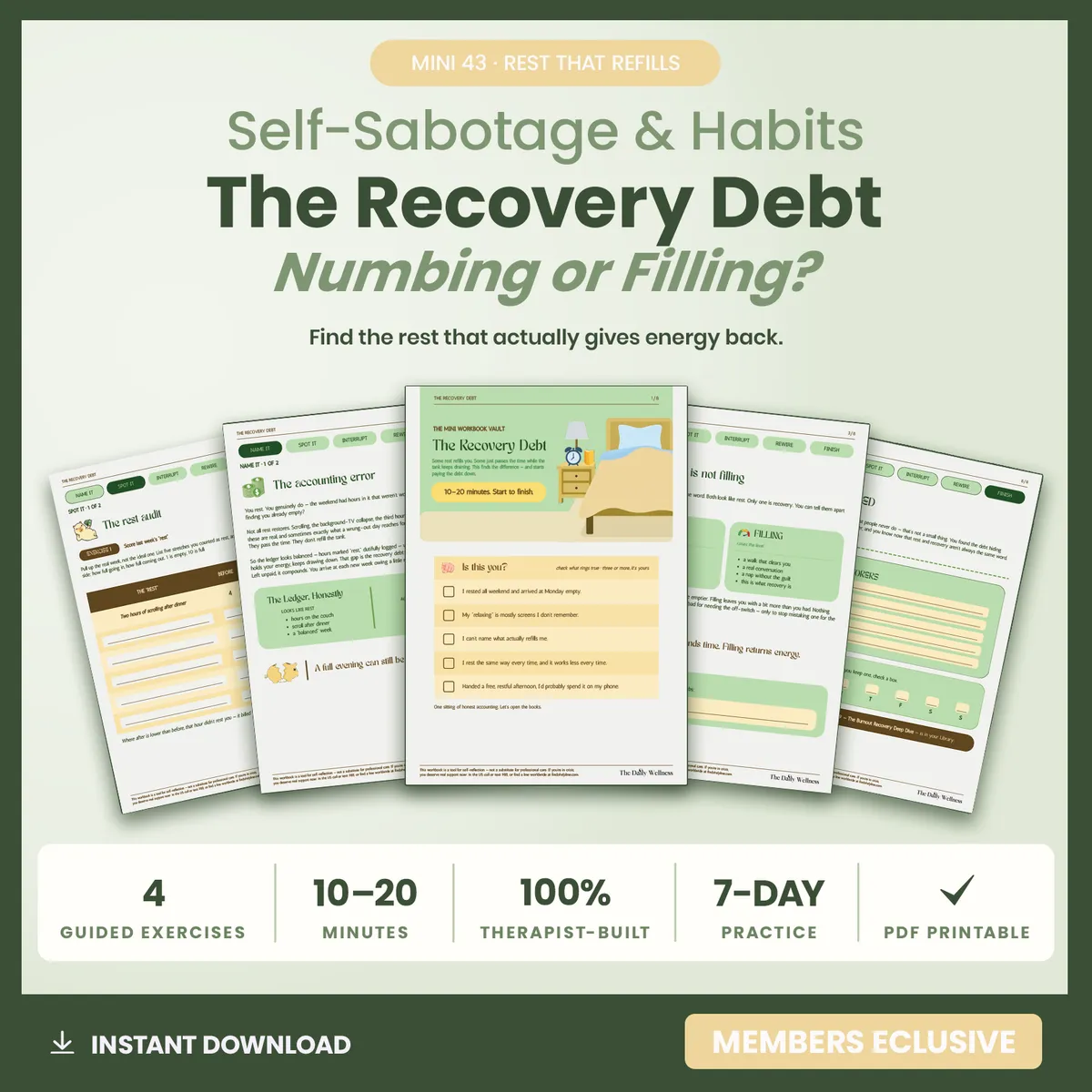
WORKBOOK 43
The Recovery Debt
Use this when: you rested all weekend and
arrived at Monday empty.
Scrolling and background TV are input, not
recovery. You audit last week’s “rest” by energy before and after, list what has actually refilled you, and protect three real blocks this week. Numbing is allowed. It just gets labeled honestly.
COLLECTION 10
Sleep & Rest
For the nights you borrow from tomorrow.
3 workbooks
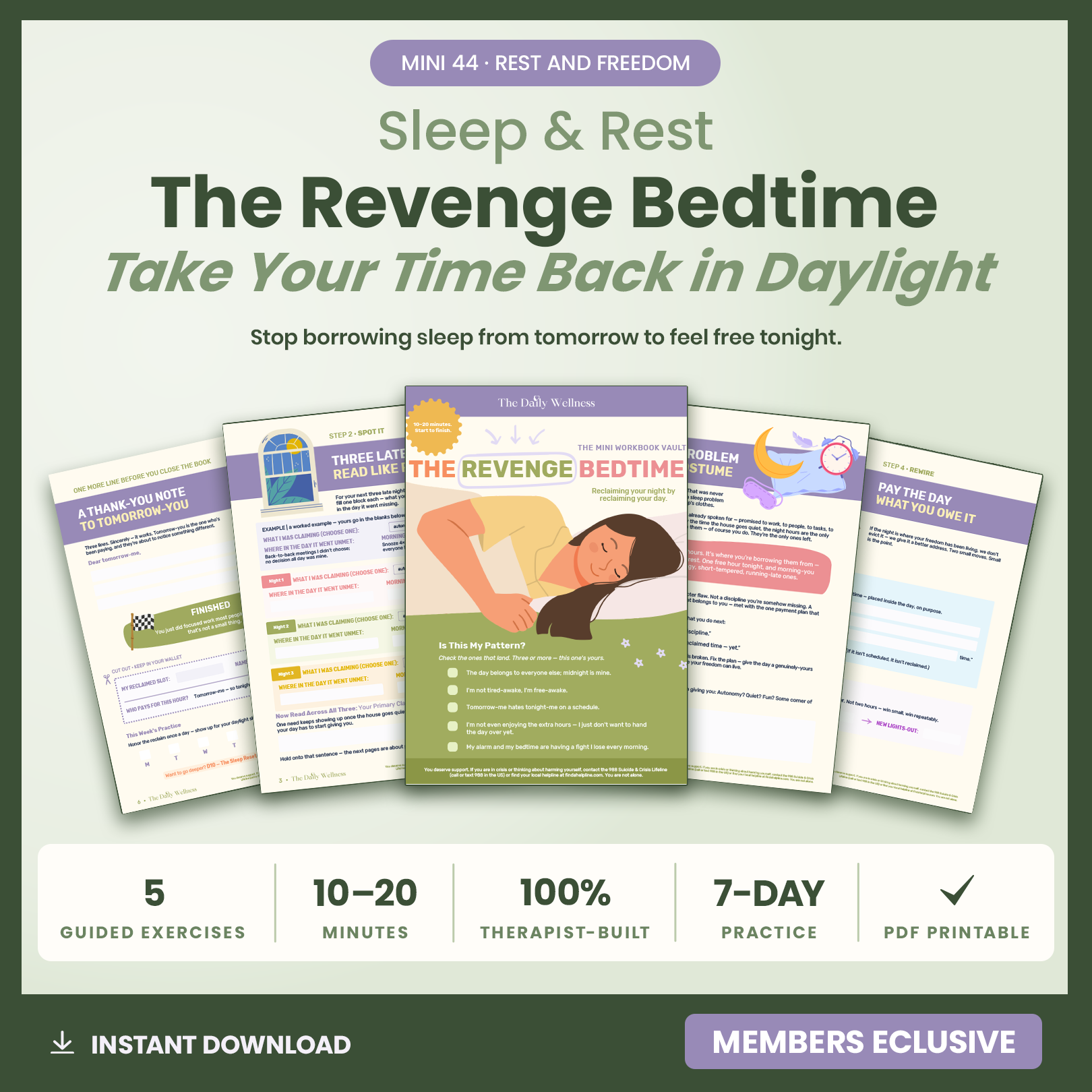
WORKBOOK 44
The Revenge Bedtime
Use this when: the day belonged to everyone else, so midnight is yours.
This is a freedom problem in a sleep costume.
The need is legitimate; the payment plan is
broken. You find what you’re claiming at
midnight, put 30 minutes of it into the day, and move lights-out by twenty minutes, not two hours.
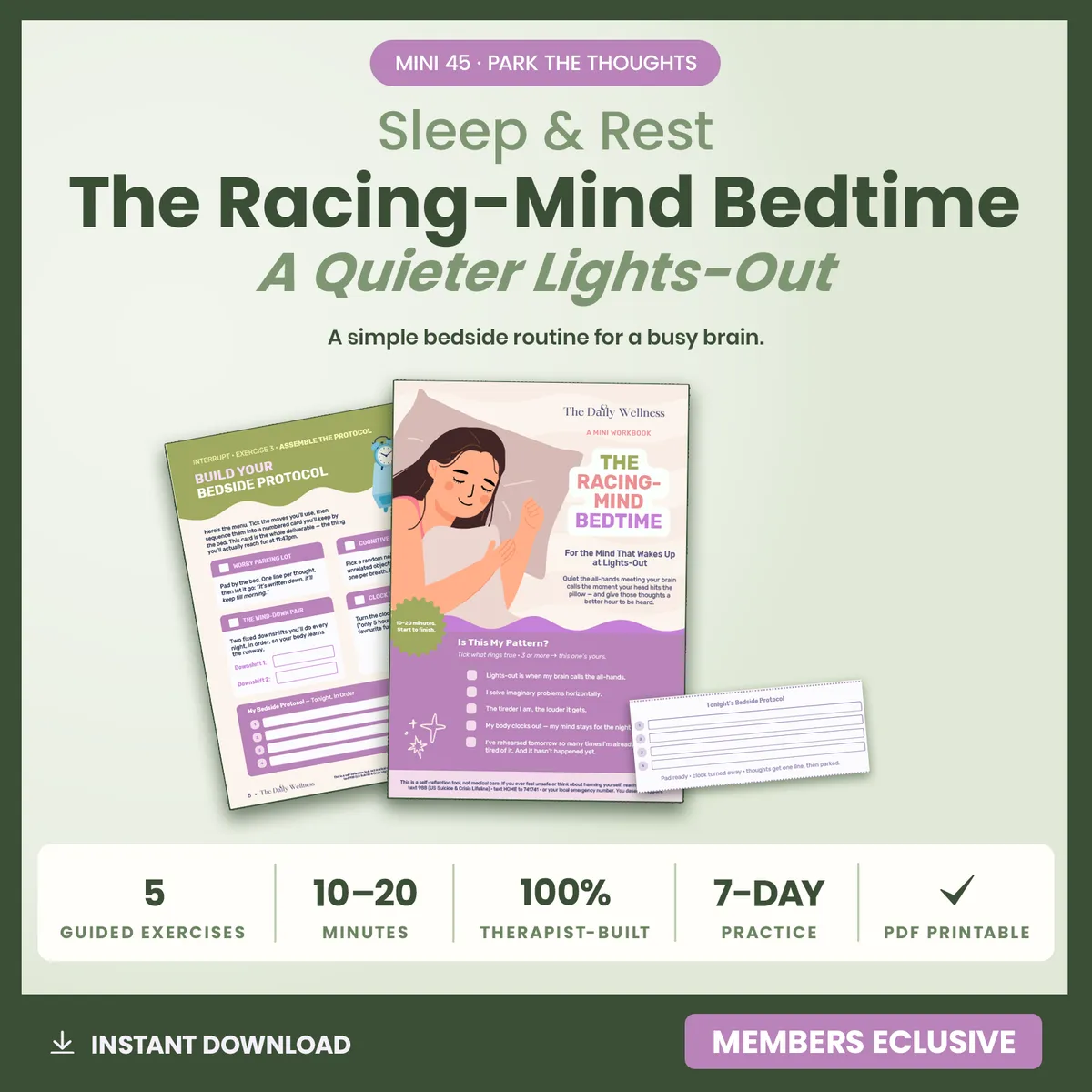
WORKBOOK 45
The Racing-Mind Bedtime
Use this when: lights-out is when your brain
calls the all-hands meeting.
Racing at night means an unprocessed day, not a broken brain. You identify your racers (worry, planning, replay) and assemble a bedside protocol: a parking-lot pad, the cognitive shuffle, a wind-down pair, the clock turned away. The card page is the protocol.
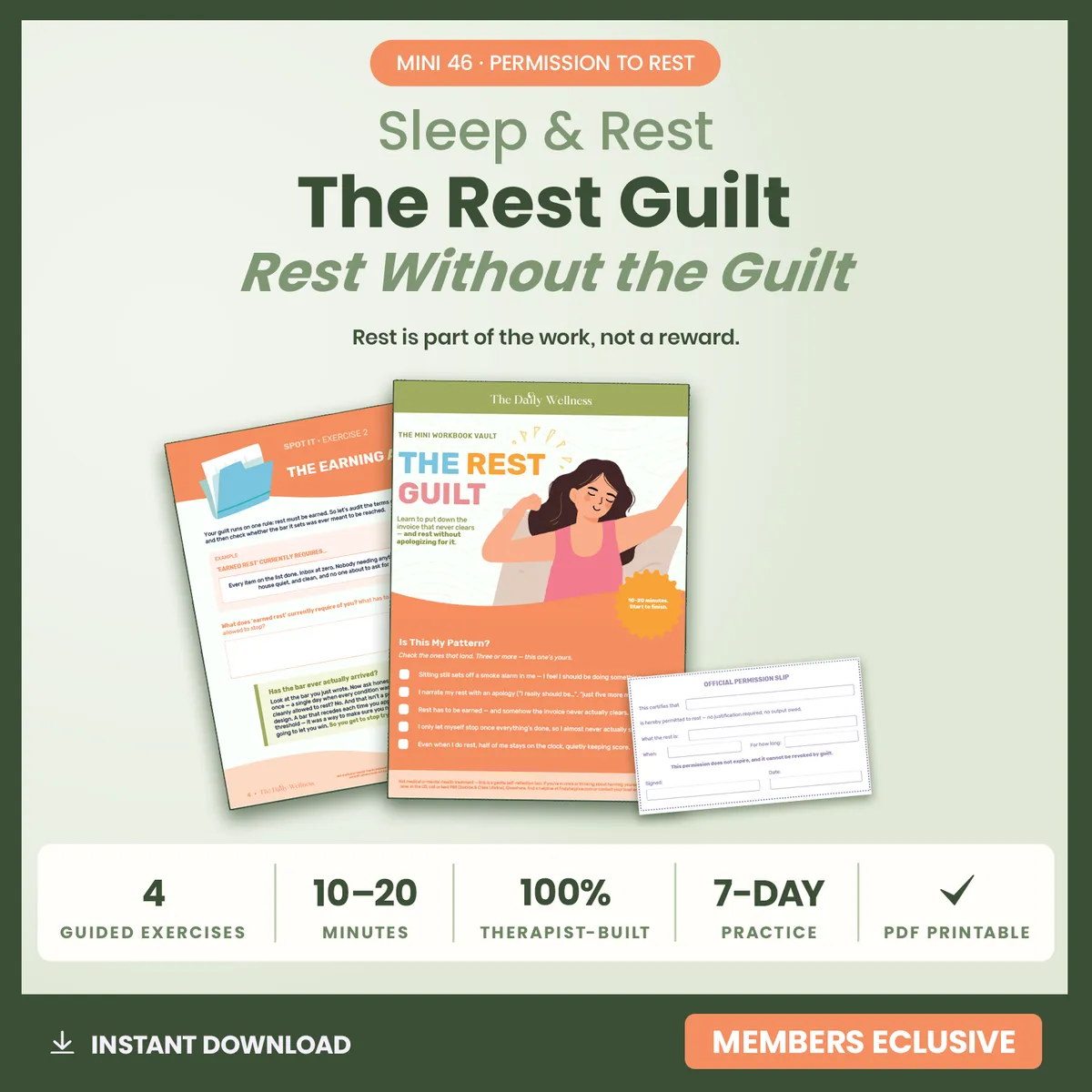
WORKBOOK 46
The Rest Guilt
Use this when: sitting still sets off a smoke alarm.
Somewhere you learned that worth equals output. Rest is maintenance, not theft. You find whose voice narrates the guilt, see that
“earned rest” has a bar that never arrives, and fill in a formal permission slip, signed and kept.
COLLECTION 11
Social Anxiety & Belonging
For the after-party your anxiety throws.
3 workbooks
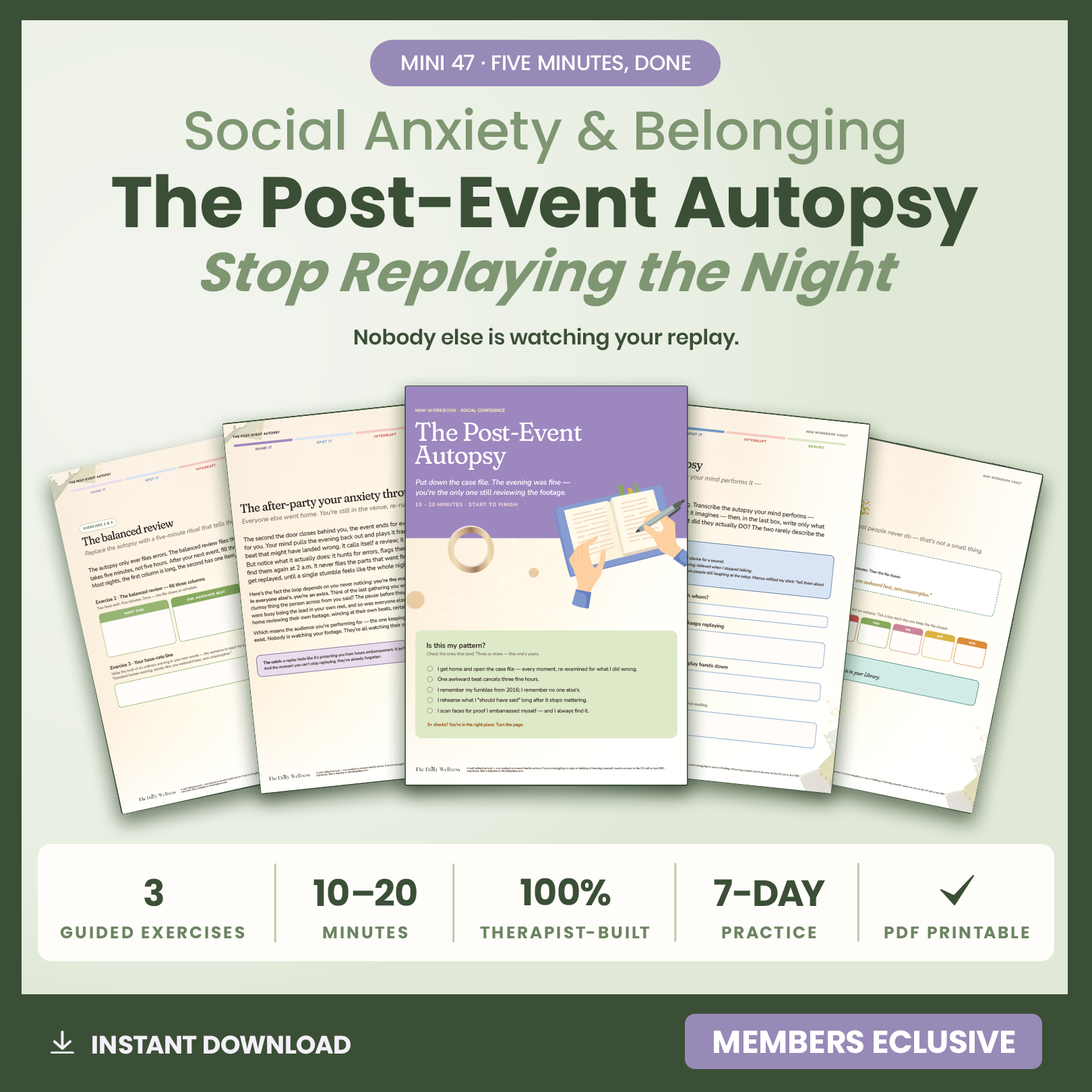
WORKBOOK 47
The Post-Event Autopsy
Use this when: you get home and open the
case file
You star in your replay. Everyone else stars in
theirs. Nobody kept your footage. You write out the “errors,” then what people actually did (usually neutral to warm), cap the replay at five timed minutes, and swap the autopsy for a three-column balanced review.
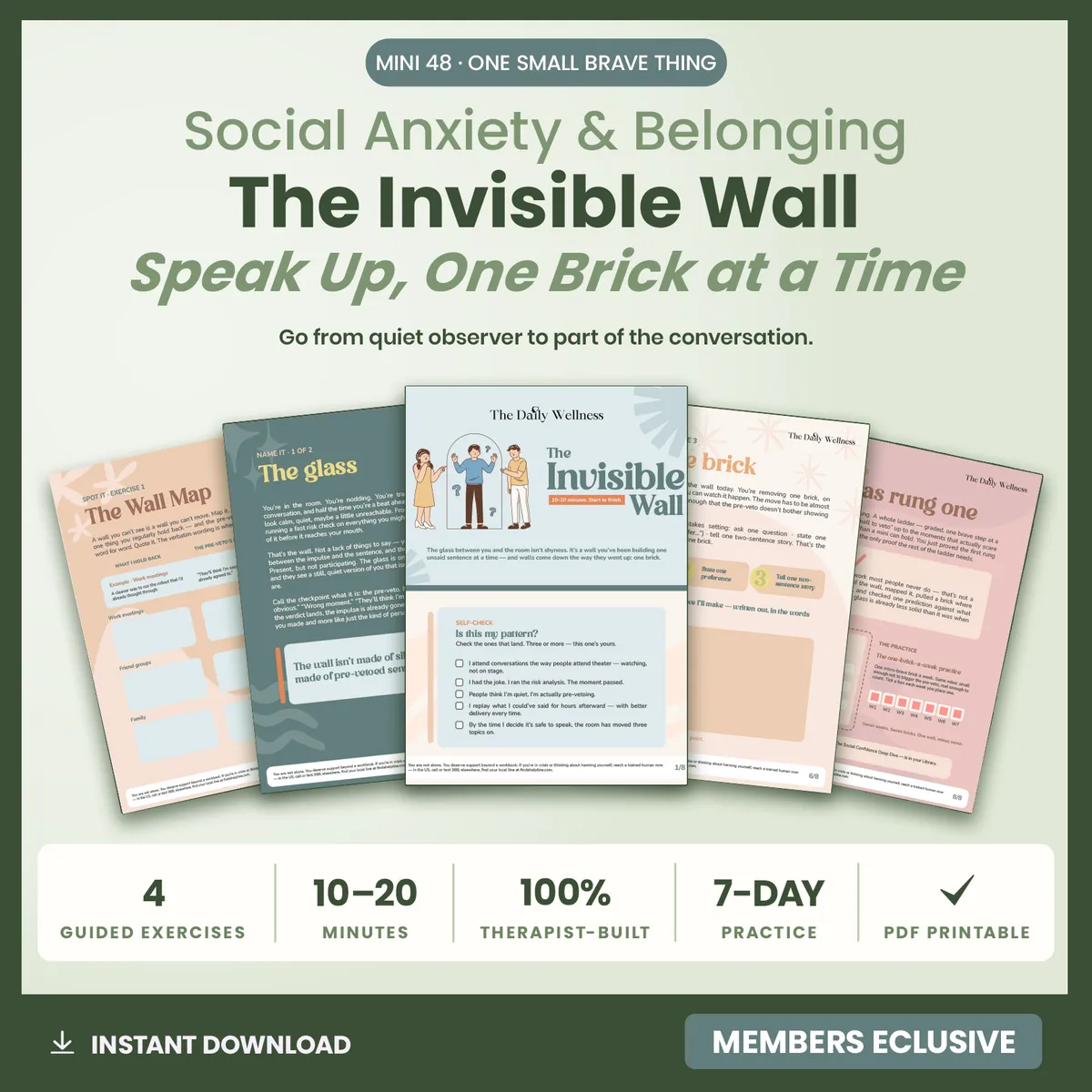
WORKBOOK 48
The Invisible Wall
Use this when: you had the joke, ran the risk
analysis, and the moment passed.
You attend conversations the way people attend theater, and every pre-vetoed moment adds a brick. You map where you hold back and what the veto predicts, then design one micro-brave action, predict the result, and compare it with what really happens.
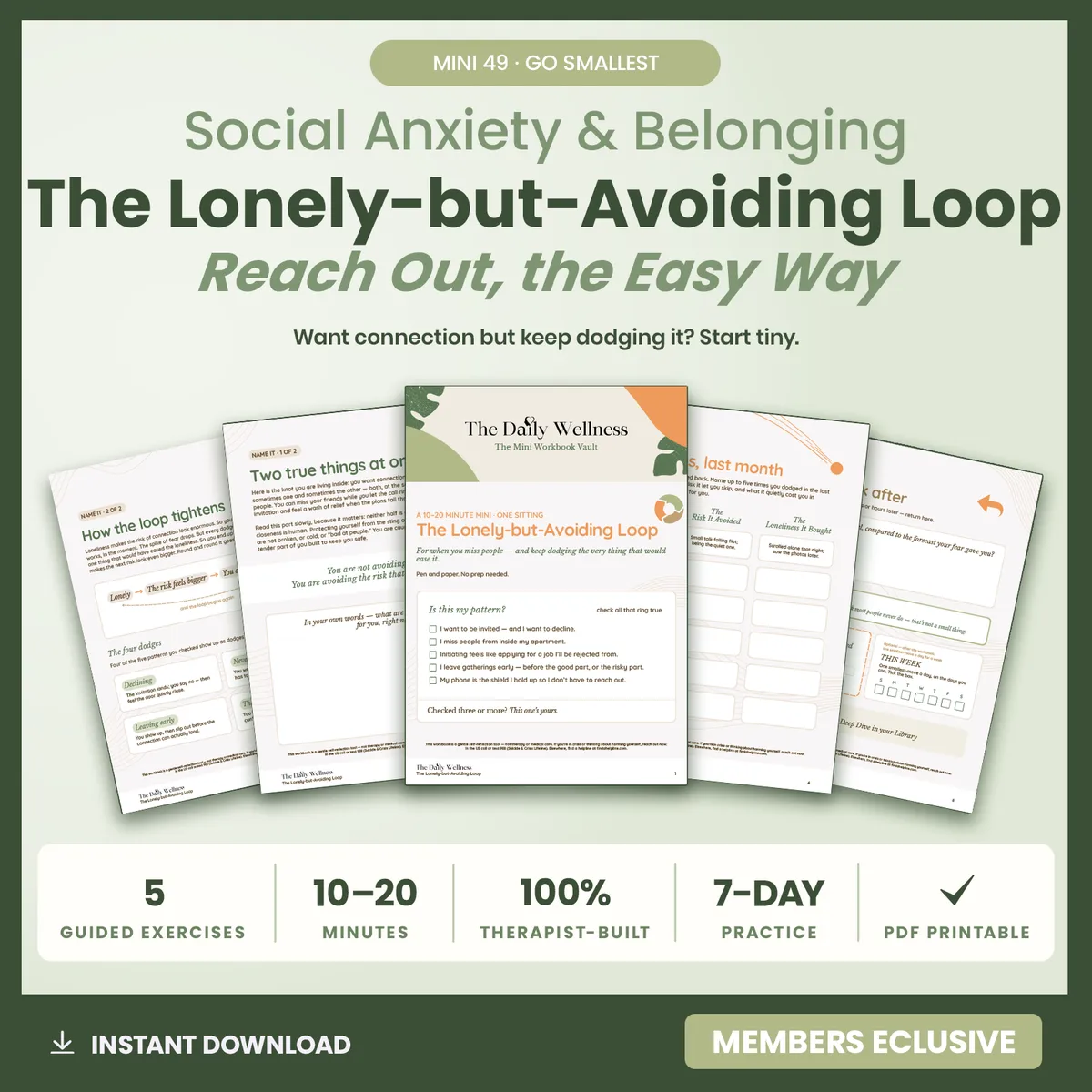
WORKBOOK 49
The Lonely-but-Avoiding Loop
Use this when: you want to be invited and you want to decline.
Both are true, and neither is a character flaw. Lonelier makes the risk feel bigger, so you dodge, and get lonelier. You catalog your
dodges, find your lowest-risk person, and send one small message during the sitting. The workbook waits.
COLLECTION 12
Change, Loss & Life Transitions
For the chapter that ended before you were ready.
3 workbooks
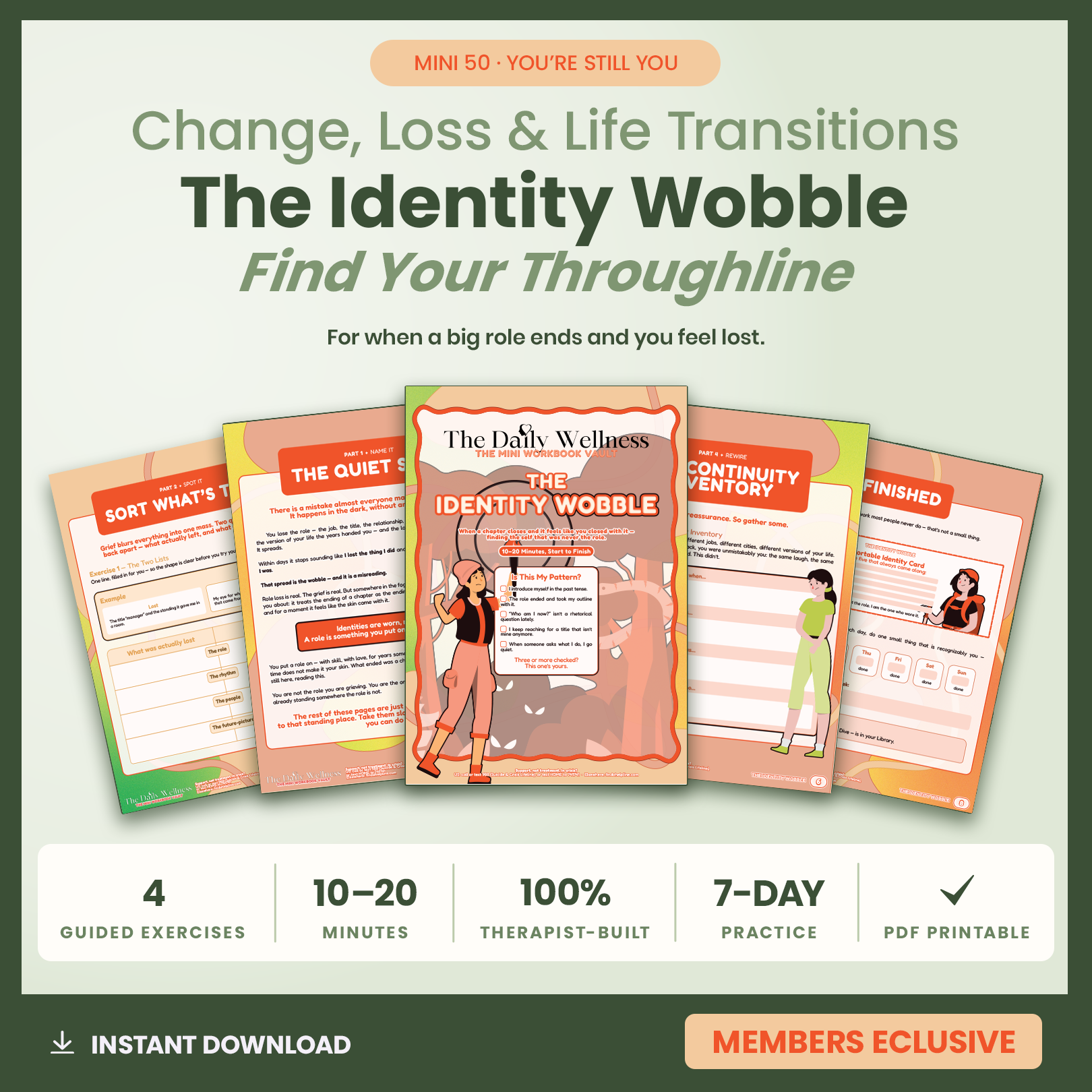
WORKBOOK 50
The Identity Wobble
Use this when: the role ended and took your
outline with it.
Identities are worn, not fused. What ended was a chapter’s costume, not the person wearing it. You list what was lost beside what persists, find five values that were true of you at 15, at 25 and now, and plan one small act that carries them forward.
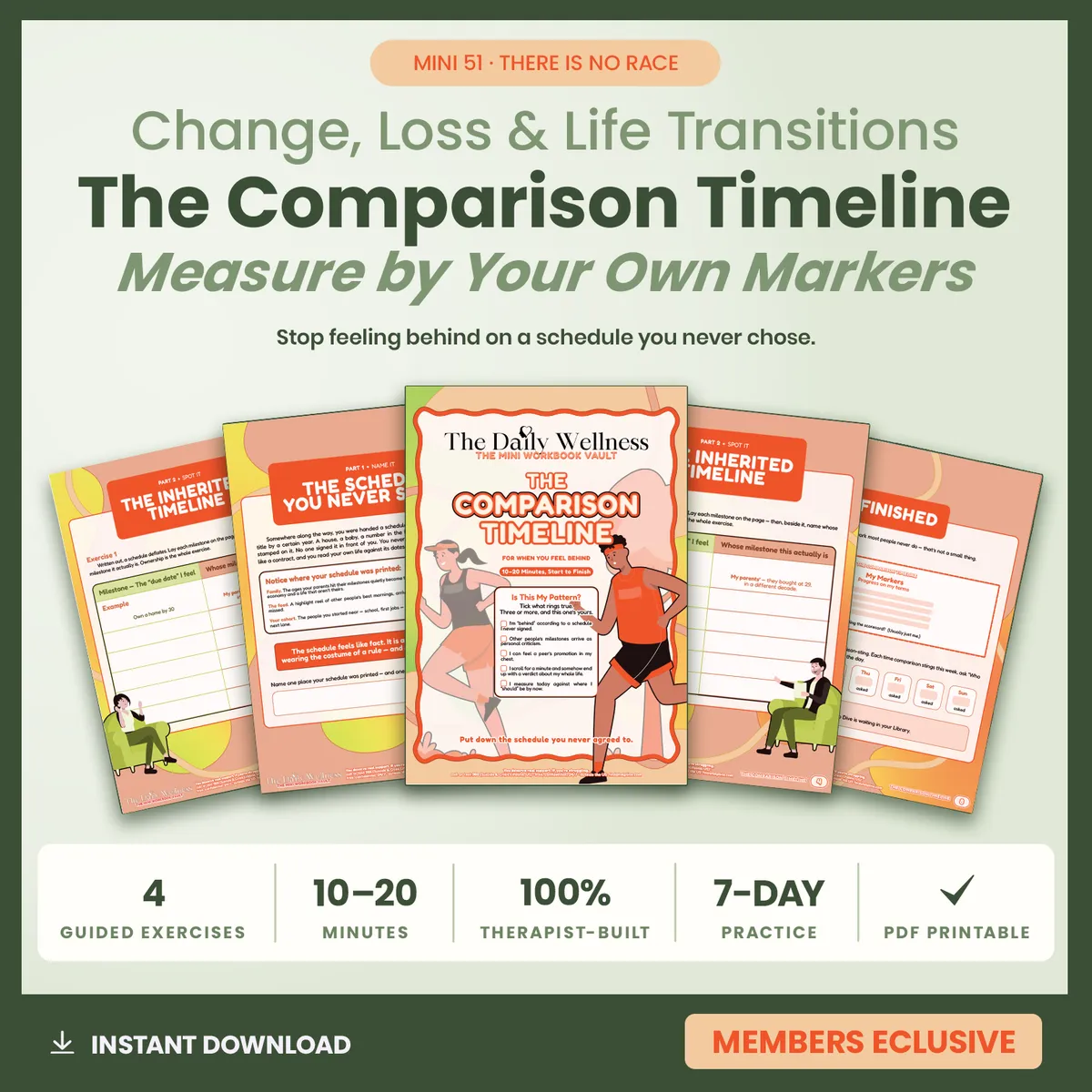
WORKBOOK 51
The Comparison Timeline
Use this when: you’re “behind” on a schedule you never signed.
Married by X, title by Y, house by Z: written out, the inherited timeline deflates. You ask who’s holding the scorecard, define four markers of progress in your own values, and mute your top three comparison triggers during the sitting, guilt-free.

WORKBOOK 52
The Letting-Go Ledger
Use this when: you’re still carrying people who left years ago.
Carrying feels like loyalty, but it’s usually just weight, and setting down is not forgetting. You inventory everything you still carry, sort it into keep, grieve and release, and write one letter you won’t send. The grieving gets its own time.
All 52 are yours for one payment. That’s 95% off, with no subscription.
TWO WAYS TO GET IT
Get the Vault on Its Own.
Or Join and Get the Whole Library.
The Vault Is One Shelf.
You Get the Whole
Library.
The Mini Workbook Vault is yours today for one payment of $19.95, 95% off, with no subscription. Want more than the Vault? Join The Daily Wellness Membership from $15 a month and get all 52 workbooks plus everything below, with every new release the day it lands.
NEW
The Mini Workbook Vault
52 workbooks. One paern, one sing, 10
to 20 minutes each.
IN THE LIBRARY
Self-Paced Courses
The deeper dives, for when a worksheet isn’t enough. At your pace, not on a schedule.
IN THE LIBRARY
Visual Cheat Sheets
Every major mental health skill on one page, for when you can’t think straight.
IN THE LIBRARY
Boundary & Conversation
Scripts
The exact words for the conversations you’ve been avoiding, ready when your mind goes blank.
IN THE LIBRARY
The Crisis Kit
For the moments that feel like too much. 38 tools, ready before you need them.
IN THE LIBRARY
The 3AM Rescue Pack
Made for the dark, not the daylight. Just
press play.
IN THE LIBRARY
The Expert Workshop Vault
Every live masterclass, organized and searchable.
IN THE LIBRARY
The Monthly Drop
A fresh bundle of guides and printables
every month, with a new theme each month.
IN THE LIBRARY
Seasonal Deep Dives
Four times a year, a guided theme for the season you’re in..
And It’s More Than a Library

A private community
People who get it, in one quiet corner of the internet. 100's members and growing.

Weekly live expert
sessions
A live session with an expert every
week. Join live, or catch the replay
in the vault.

Something new every month
A Monthly Drop, plus a Seasonal Deep Dive four mes a year.
A NOTE FROM US
We used to sell every bundle on its own, which meant the tool you needed in March was usually the one you hadn’t bought. So everything we make now lives in one place, for one small monthly price, and everything new goes there first.
If you’ve bought a bundle from us before, it’s all yours.
The Daily Wellness Team
Instant access to our private member area on Skool, on the web or in the app.
See Why 100,000+ People Love The Daily Wellness

4.85 | 100,000+ Members










CREATED AND REVIEWED BY LICENSED THERAPISTS · ONE PATTERN, ONE SITTING · 100,000+ MEMBERS
52 Workbooks. 12 Collections.
Pay Once, or Join and Get Everything.
Get all 52 mini workbooks for $19.95, once, no subscription. Or join The Daily Wellness Membership from $15 a month and get the whole library with it. Either way, you finish your first workbook tonight.
4.85 stars from 1,000+ verified reviews | 100,000+ customers
52 MINI WORKBOOKS · 12 COLLECTIONS · INSTANT DOWNLOAD
Secure checkout
Instant Access
Cancel Anytime
How it works

Enter your name and email. That's all we need before payment.

Choose how you want it. The Vault on its own for $19.95 once, or the whole membership, monthly or yearly.

You’re in. Paid once? Your 52 workbooks open on the next page and land in your inbox. Joined? Your Skool invitation arrives by email. Then pick the pattern that's loudest this week.
No contract. Keep what you download.
Pay once and there's nothing to cancel. Join and you can leave anytime from the link in any billing email. Either way, everything you've downloaded stays yours.
“…this has been and will continue to be an excellent supplement to my ongoing therapy… If you were on the fence about getting it, don’t be! It’s worth it!”
RThomas · Verified review of a Daily Wellness workbook
Trusted by 100,000+ members
Your offer is reserved for:
Limited offer • Pay once or join
The Mini Workbook Vault
one payment, yours to keep
$312+
$19.95 once
95% off • under 40¢ a workbook
or join the full membership from $15/month
Complete the form below to get instant access:
All 52 mini workbooks across 12 collections
52 wallet cards and 7-day micro-practices
Instant download, start your first workbook tonight
Pay once and keep it, no subscription
Or join for the whole library, the community and every new release
LOWEST PRICE AUTO-APPLIED









Your information is secured with 256-bit SSL encryption. Pay once and your downloads open on the next page. Join and your invitation to the member area on Skool arrives by email within minutes. No hidden fees.
Billing terms: The Vault on its own is a single charge of $19.95 USD with no recurring billing. The membership is $15 USD a month or $99 USD a year, charged to your card by The Daily Wellness when you join and then every month or year until you cancel. Cancel anytime from the link in any billing email or by emailing [email protected]. Whichever you choose, anything you've downloaded is yours to keep.
WHY THIS IS A SAFE YES
We Don’t Offer a Money-Back Guarantee.
We Offer Something Simpler.
Read this part carefully. It’s the reason joining is an easy decision.
100,000+
MEMBERS
Trusted with their hardest days

1,000+
FIVE-STAR REVIEWS
Verified buyers, not friends or family
38
CLINICALLY REVIEWED TOOLS
Built on skills therapists teach. Not recycled advice.
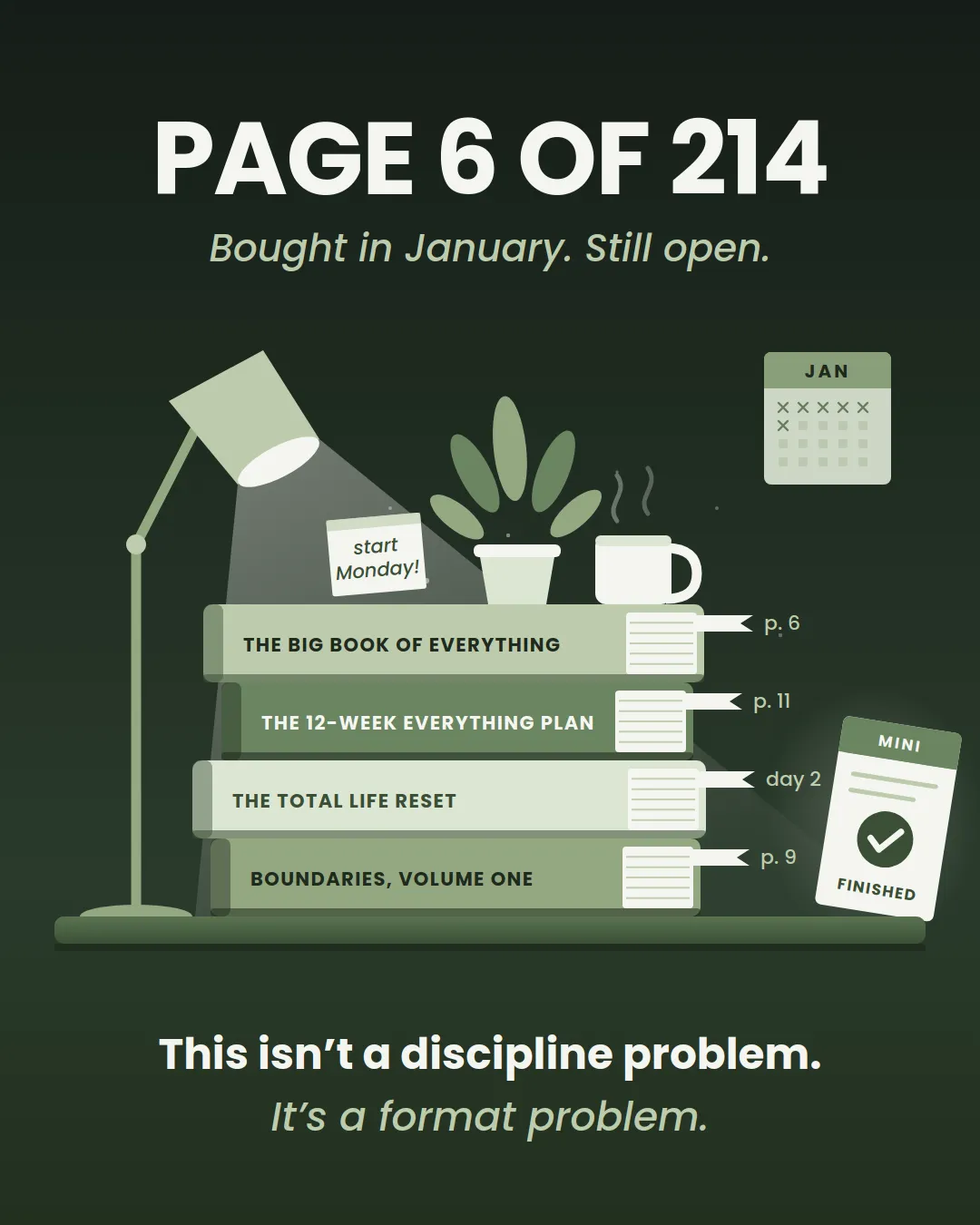
If you own a workbook you never
finished, you’ve been let down
before.
You bought it on a motivated Sunday. Did the first
chapter. Meant to go back. It’s sll on the shelf at page
six, quietly confirming the story that you don’t follow
through. You’ve learned to be skepcal because you’ve
had to be.
We get it. It’s why every mini ends the same way: a
page that says FINISHED, in the same sitting you started.
Let’s be honest for a second.
There’s no money-back guarantee on the Vault. At $19.95, 95% off, we don’t think it needs one. Here’s what you get instead:
One payment. Nothing to cancel. $19.95 once, with no subscription, no renewal and no surprise charges.
Keep everything you download. Every workbook and every wallet card is yours to keep, print and come back to.
About 38¢ a workbook. That’s less than a coffee for all 52, and each one takes 20 minutes to finish.
Want the whole library? Join the membership from $15 a month instead. You get the Vault plus eight more shelves, and you can cancel anytime from the link in any billing email.
SO HERE’S THE WORST CASE:
You spend $19.95 once, download all 52 workbooks, and keep every one. Nothing to cancel.
The best case is that you catch the old paern mid-move, and make a
different one
$19.95 once · no subscription · yours to keep
Or join the full membership from $15 a month.
WHO IT’S FOR
Is This for You?
It’s for you if…
You can describe your patterns perfectly and still keep
repeating them.
You’ve bought big workbooks before and stalled by
chapter two.
You have fifteen minutes, not fifteen weeks, and you’d
like to finish something.
It’s not the right tool if…
You’re in danger right now. Please stop reading and call or text 988 (US) or your local emergency number.
You’re looking for therapy or treatment. These
workbooks sit beside professional care. They don’t
replace it, and several of them tell you plainly when it’s
me for more.
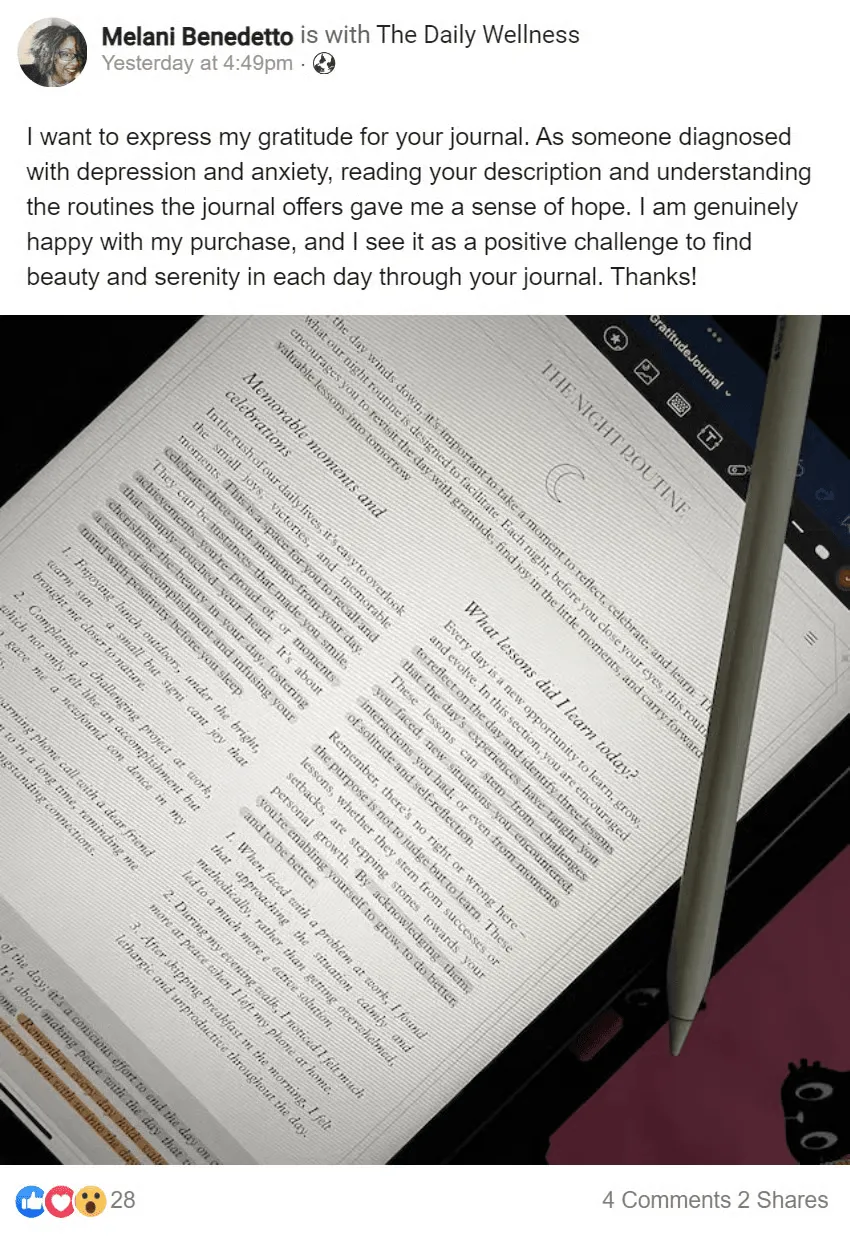
The People Who Do This for a Living Use Our Tools Too
“As a therapist myself, I highly recommend this journal. I have recommended it to clients and am loving it for myself. I gave a copy to all my daughters.”
Rebecca Esser · Verified review of a Daily Wellness journal
“I have found that I am using The Daily Wellness documents
for myself and my clients.”
Shaun Hill · Verified review of The Daily Wellness tools
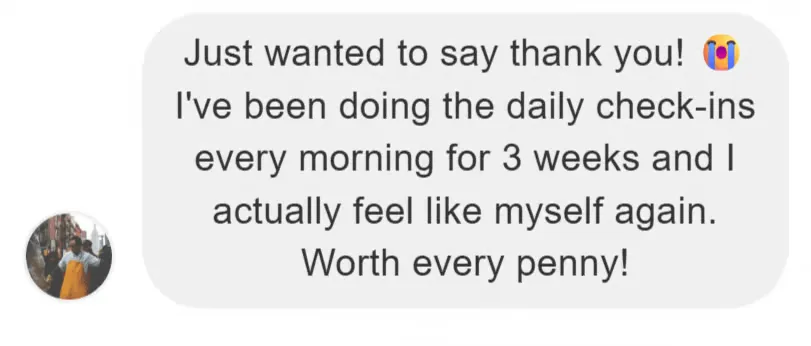
What customers say about The Daily Wellness tools
BEFORE YOU DECIDE
Seven Honest Answers Before You Join
Is this a one-time purchase or a subscription?
Your choice. Get the Mini Workbook Vault for one payment of $19.95, 95% off: all 52 workbooks, yours to keep, with no subscription. Or join the full membership from $15 a month for the whole library, and cancel anytime.
What if I join and it’s not for me?
Bought the Vault? There’s nothing to cancel, and every workbook you download stays yours. Joined the membership? Cancel anytime from the link in any billing email, and you keep everything you downloaded.
I’ve bought things like this before and never opened them. Why is this different?
Because most tools ask you to read, remember and decide, which is exactly what you can’t do when you’re overwhelmed. These ask you to press play, or follow one big-print line. And you won’t face 38 files alone: the 20-Minute Setup Guide puts the audios on your phone and your plan on one page in a single sing. Aer that, the kit is simply there.
How do I join, and how fast do I get the kit?
Within minutes. Buy the Vault and you’ll get an email invite to our member portal, where all 52 workbooks are ready to download. Join the membership and your Skool invitation arrives by email instead.
I’ve already bought bundles from you. Are they still mine, and why would I join?
Yes, they’re still yours, exactly as before. The Vault is new: 52 short workbooks we haven’t sold before, $19.95 once. The membership includes it plus everything else we make.
Is this a replacement for therapy?
No, and it isn’t meant to be. These are supportive self-help tools built on skills therapists teach, and they sit well beside professional care. Members tell us they use our tools between sessions, and one of the 38 tools is a plain guide to when it’s me for more help.
If you’re in danger right now, please don’t start here: call or text 988 (US) or your local emergency number.
Why should I get it now?
Because 95% off ends when the countdown does. And the pattern you’re thinking of will fire again before next month. Twenty minutes tonight, and the interrupt line is in your pocket before it does.
That’s everything. The rest is up to you.
$19.95 once · no subscription · instant access · yours to keep
Or join the full membership from $15 a month.
Another question? Email [email protected] and a real person will answer.

Empowering Mental Wellness For 100,000+ Satisfied Members
Disclaimer: The bundle is an educational and self-help resource for informational purposes only. It is not a medical product, clinical treatment, or a substitute for professional mental health care, and nothing in it constitutes medical advice, diagnosis, or therapy. “Clinically reviewed” refers to general alignment with evidence-based therapeutic frameworks and does not mean this product has been tested or approved as a treatment for any condition. Individual results vary and are not guaranteed. This product is intended for adults.
If you’re struggling right now, this toolkit is not crisis care. If you are in immediate danger, or the voice has moved from harsh to telling you people would be better off without you, please contact your local emergency number or a crisis line. In the US, call or text 988. Anywhere else, findahelpline.com lists free, confidential support by country.
Your Information is 100% Secure And Will Never Be Shared With Anyone. This website is not a part of the Facebook website or Facebook Inc. Additionally, this website is NOT endorsed by Facebook in any way. Facebook is a trademark of Facebook, Inc.